Exploring Alnitak: A Stellar Beacon in Orion
Alnitak, a star in Orion, shines ten thousand times brighter than the Sun. This article explores its characteristics and the surrounding celestial objects.
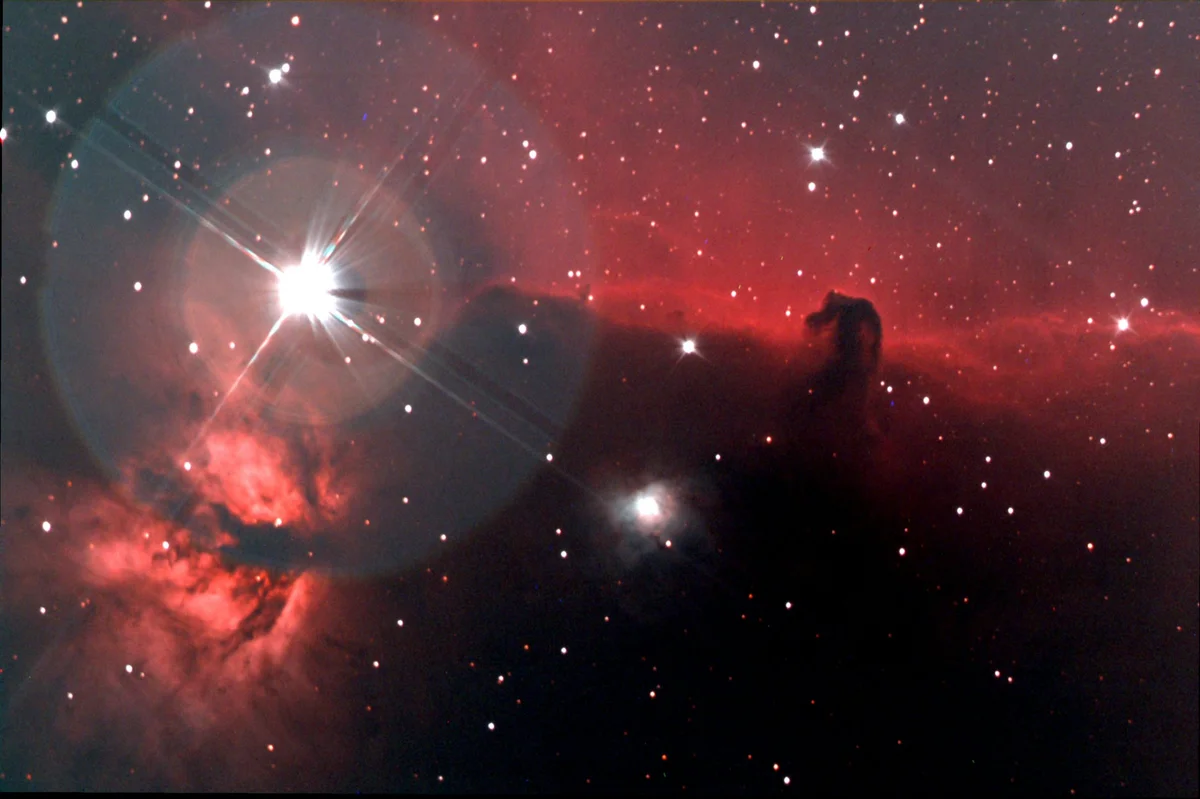
Located 1,260 light-years away from Earth in the constellation Orion, Alnitak stands as a luminous giant, shining ten thousand times brighter than our Sun. The name Alnitak, derived from the Arabic Al Nitak or Alnitah, translates to “The Belt.” This designation actually refers to all three central stars of Orion, including Alnilam and Mintaka. Historically, the Chinese referred to these stars as the “Balance Beam with Weight,” associating them with the sword of Orion, which houses the renowned Messier 42 nebula.
The Star
Astronomically speaking, Alnitak is relatively young, estimated to be around 7 million years old, especially when compared to our Sun's age of approximately 4.5 billion years. Such youth is typical for a supergiant star; these massive celestial bodies have a brief yet brilliant existence, rapidly consuming their hydrogen fuel for nuclear fusion in just a few tens of millions of years. With a mass at least thirty times that of the Sun and a radius twenty times greater, Alnitak primarily emits its luminosity in the ultraviolet spectrum, making it even more radiant—about eighty thousand times brighter than the Sun at those wavelengths. To the naked eye, it appears as a striking bluish star with a magnitude of 1.7, ranking as the thirtieth brightest star in the night sky and the fifth in the Orion constellation.
However, Alnitak’s characteristics extend beyond its brightness; it is also a binary star system. Its companion, a blue giant of magnitude 4.2, was discovered in 1819 by amateur astronomer George K. Kunowsky and is located just 3.2 arc seconds away from Alnitak. These two stars orbit around a common center of mass with a period of about 1,500 years, at an average distance of 102 billion kilometers, with an orbital inclination of 72 degrees. The complexity deepens as a third companion, designated Alnitak Ab, was identified in 1998. This unseen star, revealed through spectroscopic studies, has a mass approximately 14 times that of the Sun and a luminosity 1,300 times greater than our star. The average distance between Alnitak A and Ab is less than 2.4 billion kilometers, with an eccentric orbit that can bring them as close as 1.4 billion kilometers. This results in an orbital period of just 7.4 years, with an apparent separation from Earth of no more than 42 milliseconds of arc—43,000 times smaller than the apparent size of the Moon in the sky. Additionally, about 57 arc seconds away lies another star of ninth magnitude, with a brightness equivalent to 13 times that of the Sun. Often referred to as Alnitak C, this star does not appear to be gravitationally bound to the Alnitak system.
The image captured on October 14, 2021, at 01:49 UTC from Sassari, Italy, clearly showcases Alnitak's extraordinary brightness and hints at the presence of its companion star B through the asymmetry in the star's halo. This photograph is a composite of six images, each exposed for 10 minutes, taken with a 250mm Skywatcher Newtonian telescope and a CCD QHY8L camera cooled to -15°C. The image also features other remarkable celestial objects, which may seem unrelated to Alnitak at first glance.
Other Celestial Objects
Prominently displayed is the Flame Nebula, known as NGC 2024, located slightly to the east-northeast of Alnitak. This diffuse nebula, primarily composed of ionized hydrogen, is marked by a dark dust cloud at its center, giving it a flame-like appearance. Discovered visually by William Herschel in 1796, its true dimensions—approximately half a degree in apparent size, akin to the Moon—were only revealed through long-exposure photography, with a real diameter of about 26 light-years. Interestingly, the ionization source for the gases in the nebula is not Alnitak itself, as its distance is too great for its radiation to influence the hydrogen atoms. Instead, a group of massive blue stars located slightly south within the nebula, specifically IRS2 and IRS2b, are responsible for this ionization.
To the south lies the smaller yet distinct NGC 2023, which reflects light from the star HD37903, located within it. This nebula is part of the Orion B region, which, along with Orion A, forms the vast Orion Molecular Complex, a massive interstellar hydrogen cloud stretching between 1,500 and 1,600 light-years from Earth.
Further south, the IC 434 nebula, another emission nebula and Region HII, is excited by the star Sigma Orionis. Extending north-south, this nebula reaches an apparent size of one and a half degrees and overlaps with the famous dark nebula Barnard 33, commonly known as the Horsehead Nebula.
The Horsehead Nebula
Barnard 33 is perhaps the most iconic dark nebula in the sky. First identified by astronomer Williamina Fleming in 1888, it is challenging to spot visually, even with powerful telescopes. This chaotic mass of gas and interstellar dust has a mass twenty-seven times that of the Sun and resembles a horse's head due to a fortunate perspective alignment. Within it lie numerous newborn stars that primarily emit infrared light. Current theories suggest this nebula has a greater density than surrounding regions and is in the early stages of disintegration due to the intense radiation from nearby stars, particularly Sigma Orionis. The entire structure is thought to be evolving towards forming a Bok globule, a denser dark nebula where stellar formation will eventually occur, with predictions of its complete disintegration within 5 million years.
The Horsehead Nebula has inspired numerous science fiction narratives, including Isaac Asimov's “Tyrant of Worlds” and Douglas Adams’ “The Hitchhiker's Guide to the Galaxy,” where planets are said to exist beyond the nebula.
Ultimately, the seemingly “foreign” objects surrounding Alnitak are not truly outsiders; they represent different stages in the grand narrative of stellar evolution. This magnificent star, like all others, originated from a stellar nursery composed of gas and dust, akin to the very materials surrounding it—and from which we, too, have emerged.
The Photograph
As mentioned earlier, the photographic details are quite intricate. The image is a composite of six ten-minute exposures taken with a 250mm Skywatcher Newtonian telescope (f/5) and a CCD QHY8L camera at -15°C, mounted on an equatorial Skywatcher EQ6Pro. Guiding was achieved using a 60/700 refractor mounted parallel to the main telescope, connected to a ZWO ASI 120MC camera, all controlled by PHD2 software. The acquisition process utilized APT (Astro Photography Tools), while processing was conducted with Maxim DL4 and finalized with GIMP and other graphic editing software.
Considerations
Capturing such celestial objects presents numerous challenges, particularly concerning proper exposure. Similar to the Orion Nebula (Messier 42), part of the frame is occupied by a bright source, requiring careful calibration and technique to ensure that all elements are appropriately represented.