Discovery of a Third Galaxy Lacking Dark Matter in the NGC 1052 Field
A recent study reveals NGC 1052-DF9, the third dwarf galaxy without dark matter, challenging conventional galaxy formation models and suggesting a common origin with DF2 and DF4.
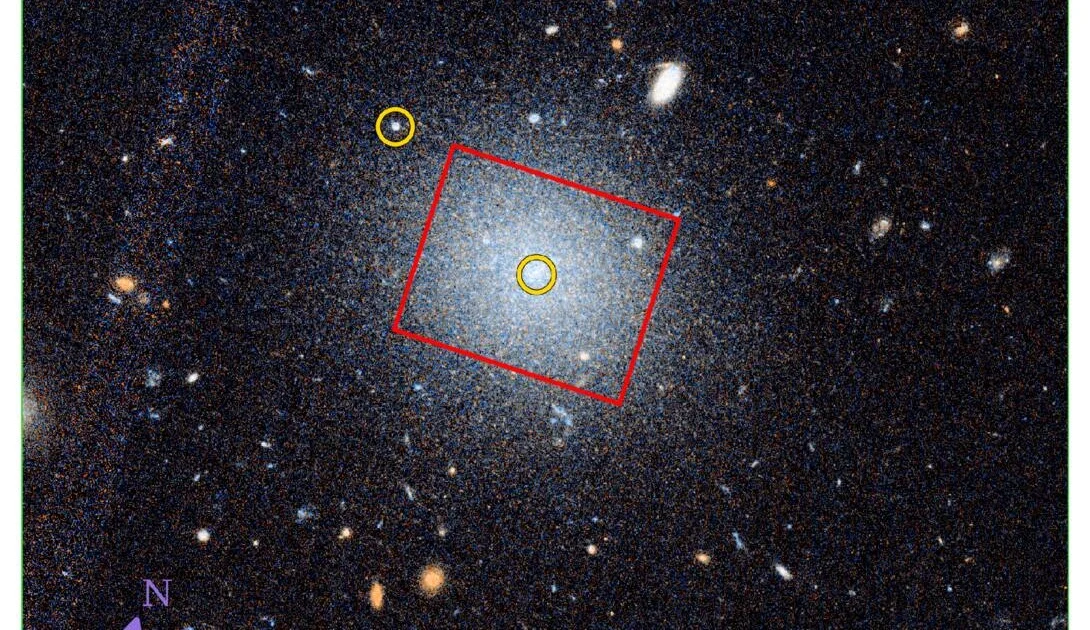
A recent study published in The Astrophysical Journal by a team of astronomers from Yale has unveiled the existence of a dwarf galaxy named NGC 1052-DF9, located 45 million light-years away from Earth. This galaxy marks the third known instance of a galaxy devoid of dark matter, following the discoveries of NGC 1052-DF2 and NGC 1052-DF4. These three dwarf galaxies appear to have formed through a similar mechanism involving the separation of gas from dark matter.
According to the standard model of galaxy formation, galaxies are typically formed within vast halos of dark matter, where cooling gas gives rise to stars. It is widely accepted that most galaxies are gravitationally dominated by dark matter. The amount of dark matter present in a galaxy is correlated with its mass; low-mass dwarf galaxies are expected to have significant dark matter content because their low escape velocities allow supernovae and other feedback mechanisms to effectively heat and expel gas. Consequently, these galaxies usually possess dark matter halos that are over 100 times more massive than their stellar mass.
The initial discoveries of the dark matter-free galaxies DF2 and DF4 by Pieter van Dokkum and colleagues in 2018 and 2019 challenged this conventional understanding. Not only did these galaxies exhibit a total mass consistent with their stellar mass alone, but they also hosted exceptionally bright globular clusters and were classified as ultra-diffuse and spatially extended. These characteristics set DF2 and DF4 apart from all other known galaxies.
In 2022, van Dokkum and his team identified that DF2 and DF4 are part of a statistically significant linear alignment of about ten faint galaxies situated in the vicinity of the larger galaxy NGC 1052. This unique alignment, tightly constrained relative to its local environment, is unprecedented among catalogs of diffuse objects. Additionally, the researchers found that the galaxies in this alignment are kinematically linked, with their speeds increasing linearly based on their positions along the alignment, consistent with the trends observed in DF2 and DF4. This strongly suggests a common origin for these galaxies, likely formed alongside DF2 and DF4. Following this reasoning, it can be inferred that the same factors responsible for the absence of dark matter in DF2 and DF4 likely contributed to the lack of dark matter in the other galaxies in the alignment.
Interestingly, a similar alignment of galaxies had been observed in simulations conducted in 2020 and 2021. This scenario, proposed by J. Silk in 2019, suggests that dark matter-free galaxies can form from gas that has been separated from its original dark matter due to a high-velocity collision. This analogy explains both the exceptionally bright globular clusters found in DF2 and DF4 and their considerable sizes, as well as the near-monochromatic nature of these globular clusters. Further simulations conducted after the discovery of the nine dwarf galaxies' alignment confirmed that their relative radial velocities, distances, and ages are compatible with a joint formation event resulting from a high-velocity collision between two dwarf galaxies. However, the most significant prediction of this scenario—that the other galaxies in the alignment, beyond DF2 and DF4, would also lack dark matter—remained to be verified.
The primary challenge in measuring the masses of the remaining seven galaxies has been their low luminosity and diffuse nature. DF2 and DF4 were discovered first as they are the brightest in the alignment, despite being ultra-diffuse. The other galaxies are up to 100 times fainter, complicating the measurement of their radial velocities and making the assessment of their internal kinematics nearly impossible. Moreover, the spectral resolution required to accurately measure the faint masses of the trailing galaxies is exceedingly high, as the velocity dispersion follows the relationship σ² ∝ M.

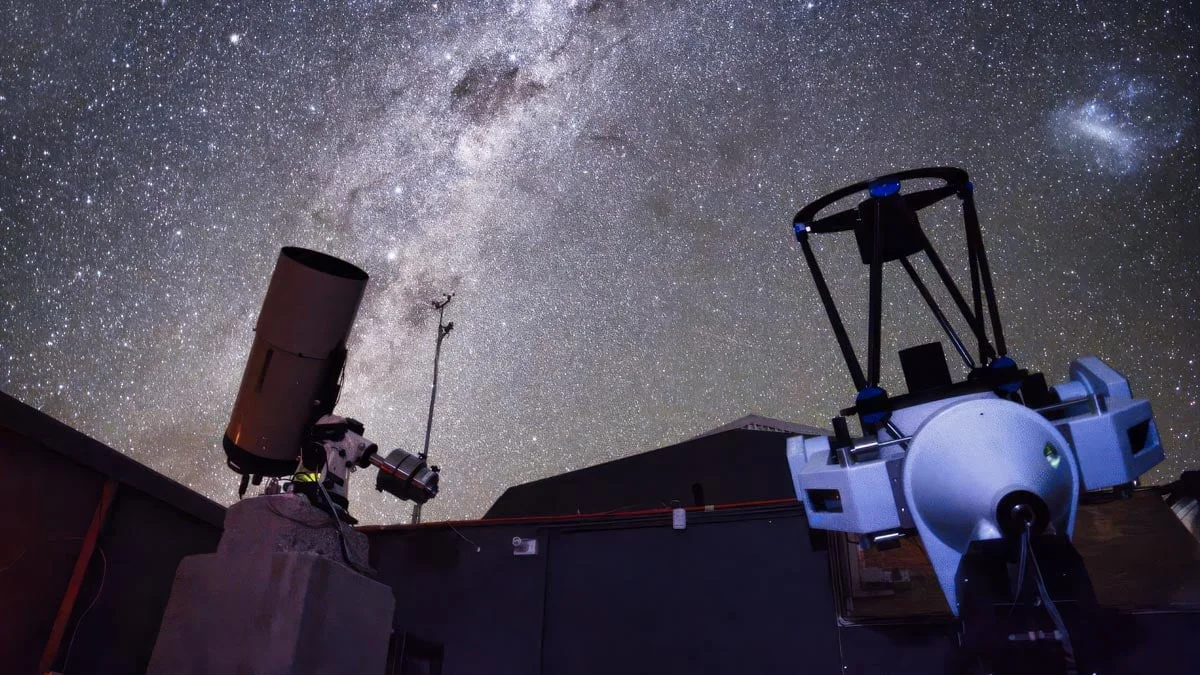
However, there is one galaxy in the alignment, NGC 1052-DF9, for which velocity dispersion measurements are feasible. DF9 is the closest analogue to DF2 and DF4, sharing similar luminosity, size, and bright cluster populations. The expected dispersions of stars and dark matter in DF9 closely resemble those in DF2 and DF4, making it ideal for recent measurement techniques using the Cosmic Web Imager (KCWI) at the Keck II telescope.
Michael Keim, a doctoral student under Pieter van Dokkum, proposed an in-depth analysis of DF9 using the Cosmic Web Imager at the Hawaiian observatory. Keim and his team measured the stellar movements within DF9 to ascertain its mass. They found that DF9 has a mass equivalent to 100 million solar masses, which aligns with the expected amount of visible matter for a galaxy of this size, with no additional dark matter detected. If DF9 contained the expected amount of dark matter, its mass would exceed 10 billion solar masses.
The researchers suggest that the absence of dark matter in DF9 strongly indicates that DF2, DF4, and DF9 formed simultaneously during a violent event, such as a high-velocity collision between galaxies. In this scenario, the collision would have separated the gas from the dark matter of the galaxies, allowing this gas to subsequently form new galaxies along a linear trajectory.
If DF2, DF4, and DF9 were the only known galaxies, one could not definitively conclude the necessity of dark matter. For these three galaxies, their dynamic mass—derived from the gravitational movement of their stars—aligns with their stellar mass, estimated from the light they emit. Although the measurement uncertainties suggest their dynamic masses may slightly exceed their photometrically estimated stellar masses, the resulting baryonic fractions would be several times greater than the universal baryonic fraction.
It is remarkable that while nearly all other dwarf galaxies studied thus far are heavily dominated by dark matter, DF2, DF4, and now DF9 appear to be devoid of dark matter and are part of a closely aligned group of kinematically connected galaxies. Keim, van Dokkum, and their collaborators are nearly certain that this set of galaxies formed simultaneously through a mechanism responsible for their dark matter deficit.
The absence of dark matter in DF9 was a strong, potentially falsifiable prediction made by van Dokkum and colleagues in 2022, following the discovery of the galaxy alignment and the hypothesis of formation through a high-velocity collision between two dwarf galaxies. Without this theory, DF9 would not have attracted significant interest. Nevertheless, the identification of this third dark matter-free galaxy represents a critical boundary in galactic formation and is essential for understanding the nature of dark matter.
This discovery also suggests that dark matter is indeed a physical substance that can act independently of ordinary matter or gas, which raises significant questions about alternative theories positing dark matter as merely a modified gravity effect.