Discovery of a Kiloparsec-Scale Cavity in a Giant Galaxy Centered Around an Ultramassive Black Hole
Astrophysicists have discovered a kiloparsec-scale cavity in the stellar distribution of the central galaxy in the A402 cluster, likely caused by dynamic interactions with an ultramassive black hole.
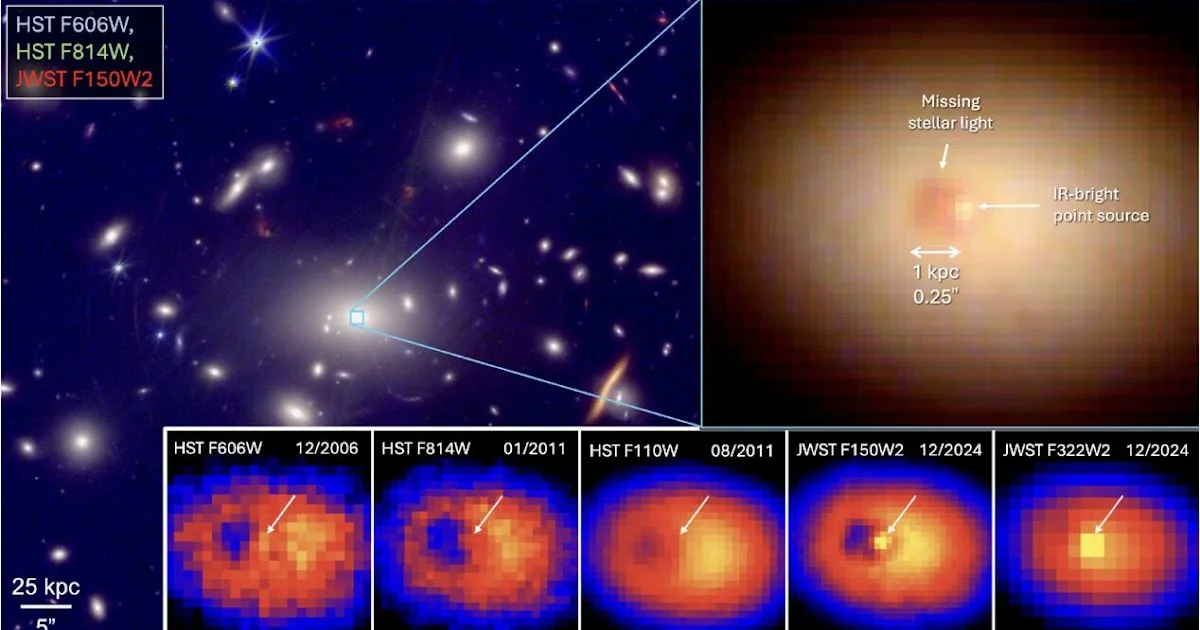
A team of astrophysicists has recently unveiled the existence of a kiloparsec-sized cavity within the stellar distribution of the central galaxy in the A402 galaxy cluster. Utilizing data from the Webb and Hubble telescopes, researchers have identified a flattened galactic core in which this cavity exists, indicating the presence of a central ultramassive black hole with an estimated mass of 50 billion solar masses (M⊙) responsible for this void. Furthermore, they have detected a second candidate supermassive black hole located on the opposite side of the cavity, moving at a relative speed of 370 km/s. If confirmed, this would suggest a binary system of ultramassive black holes separated by several kiloparsecs, making it the most massive binary black hole system discovered to date. The findings are detailed in a recent publication in The Astrophysical Journal.
The observed void corresponds to approximately 20 billion M⊙ of missing stars within a volume of 0.5 kpc³. Michael McDonald from MIT and his colleagues propose that this unique stellar cavity results from a brief dynamic interaction involving at least one supermassive black hole and the surrounding stellar field. They suggest that this interaction could arise from either a three-body scattering event during the hardening of the binary system or the induction of a dipolar instability in the stellar density field.
In the centers of the most massive galaxies in the universe, particularly giant elliptical galaxies, luminosity profiles flatten to form a central region of constant surface brightness. However, the existence of such a stellar core is not naturally predicted by current models of massive galaxy formation within a ΛCDM universe. This discrepancy implies that a secondary mechanism is responsible for the removal of stars from high-density inner regions. Given the mass of the evacuated stars, the most plausible hypothesis is the ongoing merger of a pair of supermassive black holes. According to standard structure formation models, massive galaxies primarily form through mergers with smaller galaxies, and since all galaxies host a central supermassive black hole, such mergers should also be common. Especially in earlier epochs, massive galaxies at the centers of clusters are expected to be sites of active merger events.
For two supermassive black holes to merge, they must first lose enough orbital angular momentum to reduce their separation to a point where gravitational wave emission can carry away the remaining orbital energy in less time than the age of the universe. Although gravitational waves from the merger of a supermassive black hole binary have yet to be detected, recent findings from NANOGraV and other pulsar timing experiments have revealed the existence of a stochastic gravitational wave background likely originating from the collective mergers of binary black holes within galactic nuclei. It is believed that the initial phase of this process, before gravitational waves become significant, involves three-body scattering between the two black holes and stars, leading to a “cleansing” of stars and dark matter in the inner layers of the most massive galaxies over a distance of about one kiloparsec. This star deficit may be further exacerbated if the merger of black holes induces a recoil on the residual black hole, which is often the case. This would push the supermassive black hole away from the center of the gravitational potential, resulting in a rapid expansion of stellar orbits behind it.
Such large and diffuse nuclei have already been observed in the stellar distributions of several massive galaxies, and it has been suggested that the physical size of the observed nucleus is directly related to the mass of the black hole that likely created it. Indeed, the mass of some of the most massive supermassive black holes has been inferred from the size of the central regions they have carved into the light profile of their host galaxies. This relationship is based on the assumption that the nucleus formed through dynamic interactions with a pair of supermassive black holes during or after their merger. Despite extensive observational efforts to study the cores of massive galaxies and theoretical attempts to predict their formation mechanisms, this model has remained poorly supported by direct observation until now. The only system where a supermassive black hole binary has been directly detected as altering the stellar distribution is NGC 5419, as reported by B. Neureiter et al. in 2023. In this system, two closely spaced point sources appear to induce kinematic disturbances in the stellar distribution, leading to the formation of a flattened core. Furthermore, these large flattened stellar cores can be dynamically unstable, as demonstrated by S. Dattathri et al. in 2025, resulting in a persistent dipole in the stellar distribution.
McDonald and his collaborators analyzed observations of the central galaxy of A402, a massive galaxy cluster located at a redshift of z = 0.322. The cavity they observe with Webb was previously noted by A. Repp and H. Ebeling in 2018 from Hubble observations, where it was interpreted as a dust region near the galactic center. However, thanks to data from Webb's Nircam imager, the researchers now present compelling evidence that this is, in fact, a stellar absence, likely due to dynamic interactions related to the merger of a pair of supermassive black holes.
In addition to this stellar cavity, McDonald and his team found that the central galaxy of A402 possesses an extremely extended diffuse core with a break radius of 2.2 kpc, over which the cavity is superimposed. They posit that such a significant core was likely formed during the past merger of supermassive black holes, leaving behind a remnant with a mass of approximately 50 billion M⊙. This “ultramassive” black hole appears on the western edge of the stellar cavity as a bright point source in the mid-infrared, coinciding with an active galactic nucleus identified by MUSE. On the eastern edge of the cavity, the astrophysicists also find evidence for a second active galactic nucleus, based on localized strong ext{[O III]} emission. These two AGNs have a relative velocity of 370 km/s, allowing researchers to calculate the combined binary mass of the system, yielding a record value of 60 billion M⊙.
McDonald and his collaborators have good reason to suggest that the stellar cavity forms through the ongoing dynamic interaction of a stellar core with spiraling supermassive black holes. This interpretation is supported by optical and X-ray evidence of recent large-scale mergers, as well as the observation of two emission line sources flanking the cavity, consistent with a massive binary active galactic nucleus. The size of the cavity and the relative velocities of the two presumed AGNs align with established theories regarding the erosion of stellar cores by spiraling supermassive (or ultramassive) black holes.
This system presents a model for a new phenomenon to seek in current and future observations. The detection of additional similar sources would help consolidate current predictions of multi-messenger signatures for future LISA detector sources, for which the timescale and frequency of mergers remain significant uncertainties.
In the future, extensive surveys conducted with the Euclid and Roman space telescopes, along with archival surveys from Hubble and Webb, are likely to uncover similar systems, providing an estimate of the timescale for supermassive black hole mergers based on the observational frequency of such systems. Concurrently, targeted follow-up of this unique system with the most powerful telescopes will allow for a more comprehensive understanding of the nature of the active galactic nucleus in this system and the dynamics of stars within and around the cavity.