Detection of Anisotropic Cosmic Structures on Gigaparsec Scales
Astrophysicists reveal persistent anisotropic structures in galaxy distributions extending up to gigaparsec scales, challenging the standard cosmological model.
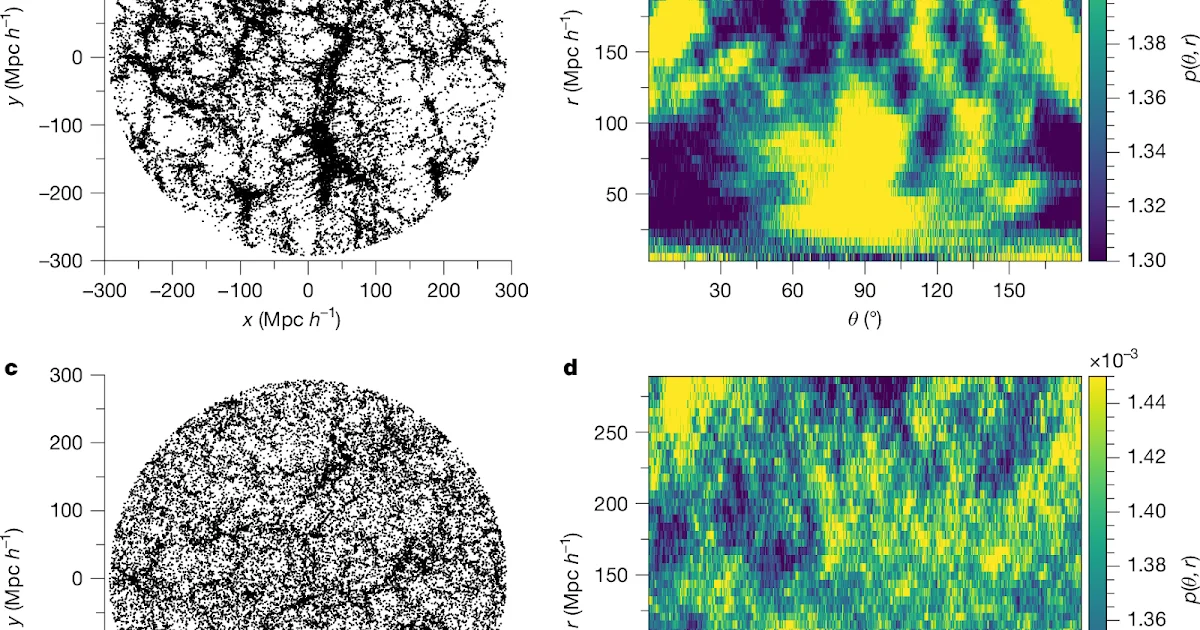
Recent research challenges the long-held cosmological principle that suggests the universe becomes statistically homogeneous and isotropic at large scales. According to the standard ΛCDM cosmological model, beyond the nonlinear regime of galaxy cluster formation, inhomogeneous and anisotropic features should fade rapidly. However, increasing evidence from the complex network of large-scale structures and voids in galaxy distributions indicates possible deviations from statistical homogeneity and isotropy.
In a groundbreaking article published in Nature, astrophysicists Francesco Sylos Labini and Marco Galoppo present findings that reveal persistent anisotropic structures in galaxy distributions extending up to gigaparsec scales, raising significant questions about the foundations of the standard model.
The spatial distribution of galaxies is a crucial observable parameter for studying the large-scale structure of the universe. Characterizing its statistical properties is challenging due to the complex patterns that extend to the largest known structures in the cosmos. A primary objective of observational cosmology is to determine the spatial extent of these structures, enabling relevant statistical comparisons with theoretical galaxy formation models.
Typically, galaxy surveys characterize clustering through angularly averaged statistics, such as the two-point correlation function or its Fourier equivalent, the power spectrum. These metrics quantify the amplitude of density fluctuations across various scales but are inherently insensitive to directional information.
Research on large-scale anisotropy has focused on specific signatures, including low-order multipoles in the cosmic microwave background or directional variations in the number of astrophysical sources. Concurrently, algorithms designed to identify morphological features like filaments, walls, and voids have been widely used to characterize the cosmic web. Initial observations reported filaments extending up to approximately 60 Mpc, while later studies revealed structures at the supercluster scale covering around 150 Mpc. More recently, structures spanning several hundred Mpc have been identified, although their statistical significance remains uncertain.
Taken together, these studies suggest that current observations could already indicate deviations from isotropy at large scales. However, most methods target specific manifestations of anisotropy, testing preferred directions rather than providing a general characterization of directional structure.
To address these limitations, Sylos Labini and Galoppo employed the Angular Distribution of Pair Separations (ADPD), a non-parametric statistic that measures directional correlations. This method directly examines the orientation distribution of pairs of galaxies at fixed separations without angular decomposition or model-dependent assumptions. It can be applied to samples of arbitrary geometry and compared directly to isotropic predictions and simulated catalogs derived from N-body cosmological simulations.
In their analysis of galaxy samples from the DESI catalog, which includes over 30,000 galaxies per sample, the researchers detected anisotropy signals exceeding those observed in isotropic controls and ΛCDM simulated catalogs, with a statistical significance greater than 3σ. The maps they constructed reveal pronounced vertical ridges, indicating an excess of galaxy pairs aligned along specific directions, persisting across a wide range of separations. These coherent filamentary structures extend over hundreds of megaparsecs and correspond to elongated patterns visible in the projected cuts. The researchers then compared these findings to simulated catalogs based on the ΛCDM model, adjusted for geometry, slice thickness, and galaxy counts. In contrast to the observations, the simulated maps exhibited only weak and ephemeral directional structures, trending toward a uniform distribution at large separations.
These results provide direct evidence that directional coherence persists at much larger scales than predicted by the standard model. For the researchers, this behavior calls into question the hypothesis of a statistically isotropic distribution of galaxies at the largest scales and invites a reconsideration of how uniformity and isotropy manifest in the observable universe, with potential implications for the interpretation of the Friedmann-Lemaître-Robertson-Walker standard model.
The detection of large-scale anisotropies stands in stark contrast to the standard formulation of the cosmological principle, which posits statistical homogeneity and isotropy at all points, while remaining compatible with the Copernican principle, which only requires the absence of privileged observation points.
From a theoretical perspective, the existence of such large-scale anisotropies motivates the exploration of more general solutions to the Einstein field equations, explicitly accounting for large-scale inhomogeneities. It also encourages the study of alternative sources that could accelerate the formation of galaxies and galaxy clusters in the early universe, such as introducing self-interaction for dark matter particles or investigating feedback effects due to inhomogeneities.
Looking ahead, the upcoming data releases from DESI, as well as forthcoming large-scale surveys like Euclid, will allow researchers to test these findings with significantly larger samples and across more extensive cosmological volumes. These observations will provide a decisive opportunity to establish whether the identified large-scale anisotropic structures extend to even greater scales, confirming the need for a fundamental evolution of our cosmological model.

Source Detection of anisotropic cosmic structures on a gigaparsec scale Francesco Sylos Labini & Marco Galoppo Nature (June 24, 2026) https://doi.org/10.1038/s41586-026-10702-5
Illustration Comparison of two-dimensional projections of the DESI galaxy sample and corresponding ADPD map with the simulated equivalent (ΛCDM model) (Sylos Labini & Galoppo)