Comet 67P/Churyumov-Gerasimenko: A Recent Observation
An account of the observation of comet 67P/Churyumov-Gerasimenko on October 8-9, 2021, including details on equipment used and mission history.
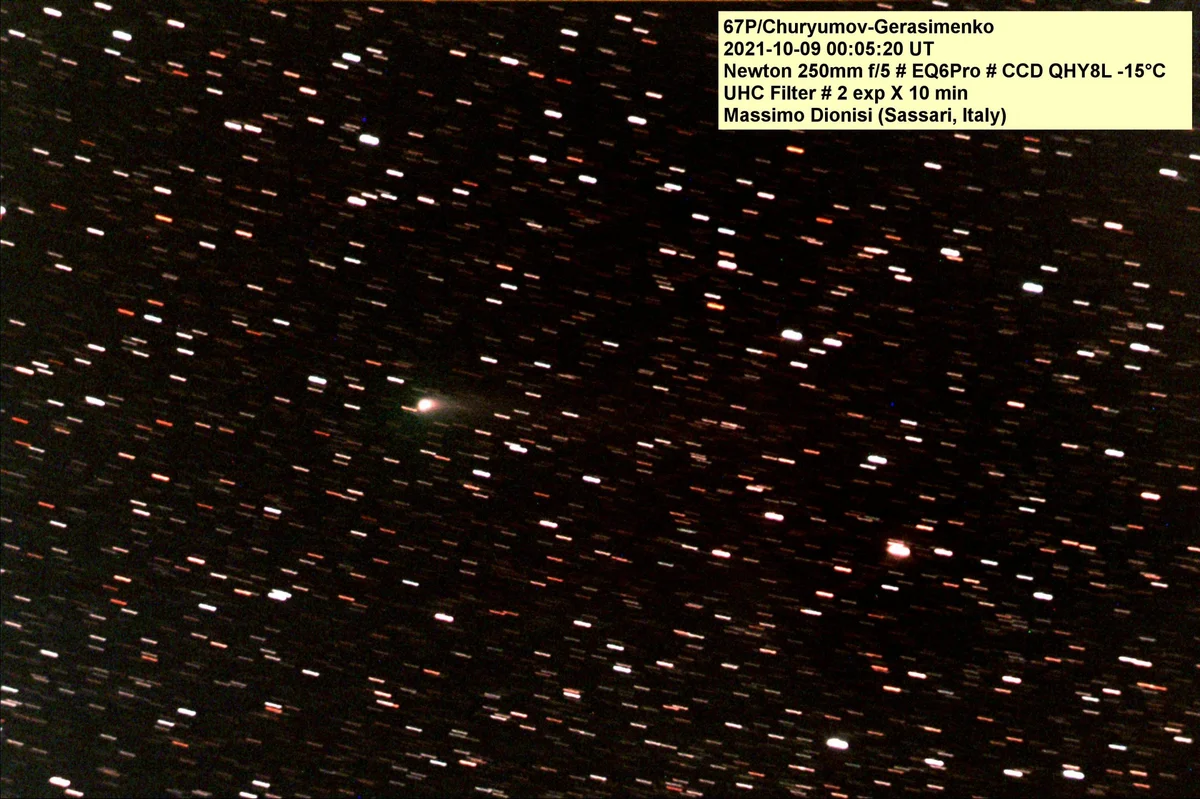
A brief account of my recent observation of the periodic comet 67P/Churyumov-Gerasimenko took place on the night of October 8-9, 2021.
Despite facing challenges due to adverse weather conditions, I fortuitously discovered a short window of visibility in the Taurus constellation, close to the Crab Nebula (Messier 1), where the comet was located that night.
For this observation, I utilized my 250mm f/5 Newtonian telescope mounted on a Skywatcher EQ6Pro, paired with a QHY8L CCD camera cooled to -15°C, along with a UHC filter to mitigate the significant light pollution present in my suburban location on the outskirts of Sassari, Sardinia. I managed to capture only two exposures of 10 minutes each before clouds obscured the sky, forcing me to conclude my observational session.
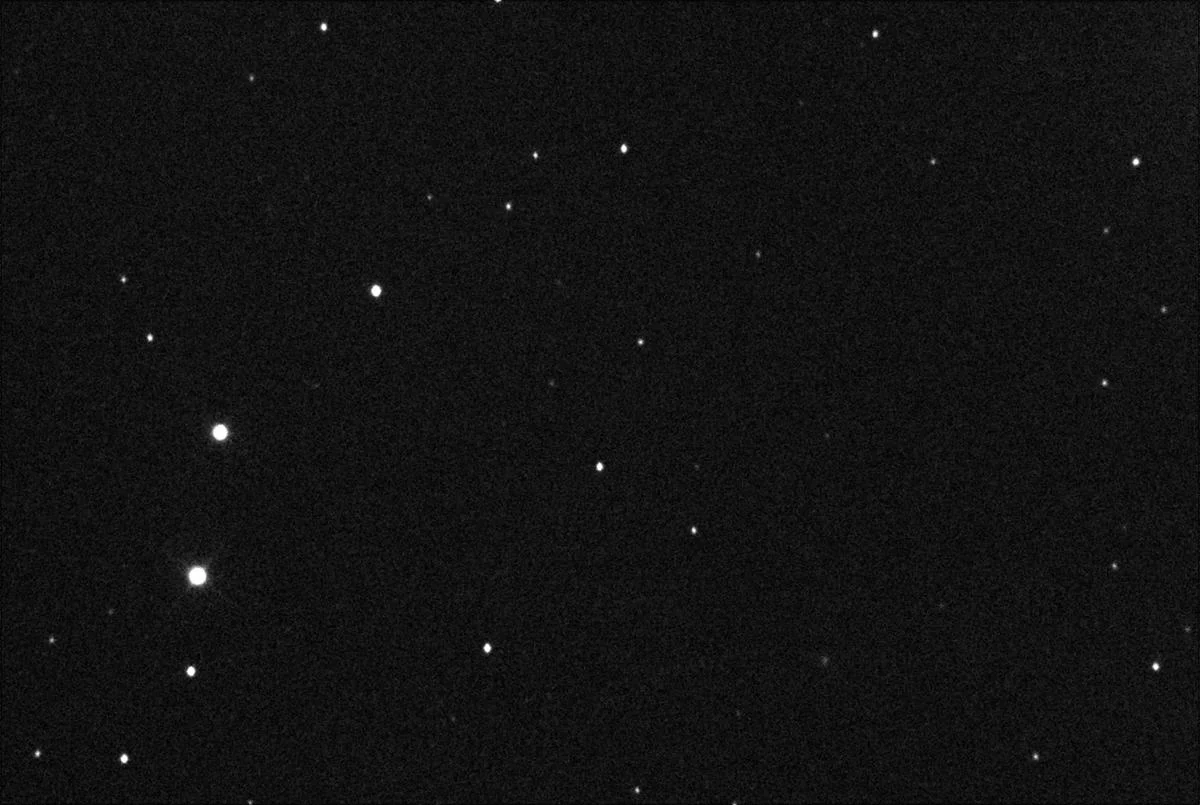
The comet exhibited an apparent motion in the sky of 2 arcminutes and 40.6 arcseconds, with a position angle of 78°. This translates to a right ascension shift of 11.42 seconds and a declination shift of 32.1 arcseconds. Thanks to the remarkable capabilities of the guiding software PHD2, combined with the SkyChart (Cartes du Ciel) application I use to control the mount, I was able to automatically track the comet by setting its proper motion, which added to the normal apparent rotation of the celestial sphere.
The outcome is visible in the image I captured, where the comet appears stationary, while the stars are represented as segments proportional to the comet's movement, which is also influenced by the telescope's focal length.
The comet's magnitude was estimated to be around ten, displaying a clear and defined coma along with a noticeable tail. The field of view provided by the telescope and CCD camera combination measured 64.9 x 43.45 arcminutes, with an image resolution of 1.28 arcseconds per pixel.
67P/Churyumov-Gerasimenko is a periodic comet discovered in 1969, with an orbital period of approximately 6.5 years. It reaches a minimum distance of 185.8 million kilometers from the Sun, while at its maximum, it extends up to 850 million kilometers away. This celestial body was selected as the target for the European Space Agency's Rosetta mission. Starting in 2003, the Hubble Space Telescope was used to initiate a dedicated observational campaign aimed at gathering as much data as possible in preparation for the mission. Astronomers were also able to create a three-dimensional model of the comet. In 2014, the spacecraft, which included a landing module, was launched. Initially, the mission aimed to collect samples from the comet's surface and return to Earth; however, due to budget constraints and technological limitations, it was adjusted to focus solely on observation via the main spacecraft in orbit around the comet from August 2014 to December 2015, alongside the landing of the Philae lander, which was intended to provide images and scientific data from the surface. Overall, the mission unfolded largely as planned, despite some inevitable technical challenges, as is common in such complex endeavors. Instruments aboard the orbital module revealed that the comet's nucleus is an irregularly shaped object, seemingly composed of two lobes that merged long ago, measuring approximately 4.1 x 3.2 x 1.3 km and 2.5 x 2.5 x 1.0 km. Collectively, it bears a striking resemblance to the asteroid 486958 Arrokoth, also known as Ultima Thule, which was photographed by NASA's New Horizons spacecraft in 2019.
The Philae lander successfully touched down on the comet's nucleus in November 2014, sending back images and data from the surface. Unfortunately, its operational time was severely limited as it landed in a shadowed area, preventing it from recharging its batteries with solar panels. Nonetheless, the mission was deemed a substantial success, achieving several milestones.