Astrocamping Experience: A Night Under the Stars
Experience a night of astrocamping at Sternenwelt Vogelsberg, where stargazing and nature combine for a perfect summer getaway. Join us as we explore celestial objects and enjoy the tranquility of the night sky.
Embracing Nature for Summer Vacation
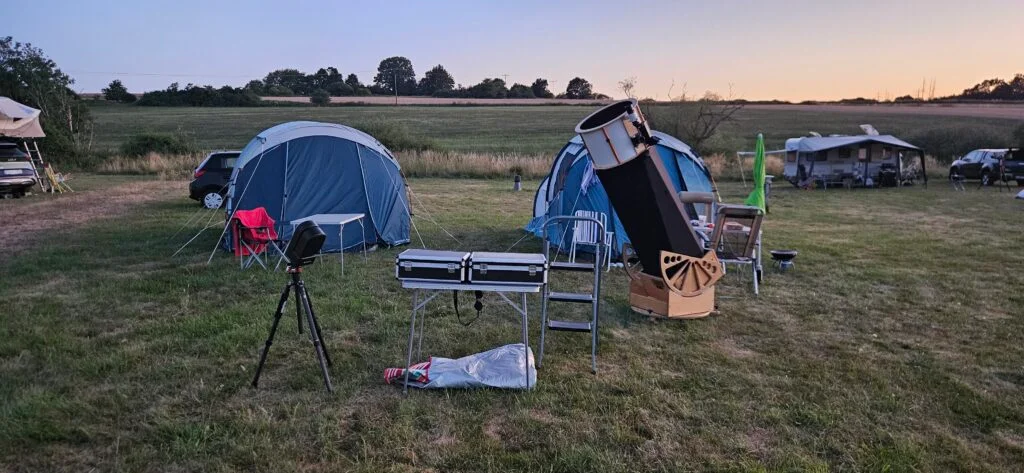
This summer, instead of traveling far, we chose to spend our vacation at the Sternenwelt Vogelsberg. For five days, we immersed ourselves in nature, enjoying the breathtaking night sky—a perfect way to unwind. A highlight of the trip was Denis from Berlin joining us, who cleverly combined his vacation with astrocamping.
Packing Challenges
On Friday morning at 7 AM, I engaged in my usual "car Tetris," trying to fit as much gear as possible into my small vehicle. Unfortunately, I had to leave behind some items, including my pavilion, wardrobe, and H-Alpha telescope. While the pavilion and wardrobe were manageable losses, I truly wished to have my H-Alpha telescope with me. By a quarter past eight, I was ready to depart, initially without my friend Ben, who had other plans. I planned to pick him up on Sunday.
Arrival at Stumpertenrod
Denis had already arrived, having set off from Berlin at 3 AM. We quickly set up our large tents and unloaded the cars before taking a moment to relax. Sitting comfortably in our chairs and occasionally closing our eyes amidst the tranquil surroundings was simply delightful.
During our downtime, I received a message from Andy via WhatsApp, announcing his spontaneous visit that evening. He had left his equipment at home, citing the short summer nights as a challenge for astrophotography. He was accompanied by his girlfriend Ella, who had work the following day.
As evening approached, Denis and I grilled some sausages, as sitting around inevitably made us hungry. After dinner, I took some time to relax while Denis went for a stroll. Just before darkness fell, Andy and Ella arrived, and we enjoyed a pleasant conversation while waiting for the night to fully set in.
The First Celestial Objects of the Night
Those familiar with my reports might expect that our first observation would be the globular cluster M13, but this time it was the Cr399 asterism in the constellation Fox that took the honor. Through binoculars, the arc of the asterism was visible, though the linear star chain was still a bit faint.
Next, we observed the globular cluster M13 in Hercules. Although it was a nice view, the still-bright sky prevented us from fully appreciating its splendor. Following that, we turned our attention to the Ring Nebula M57 in Lyra and then to one of my favorite objects, the Owl Cluster NGC 457 in Cassiopeia.
The Sky Reveals Its Wonders
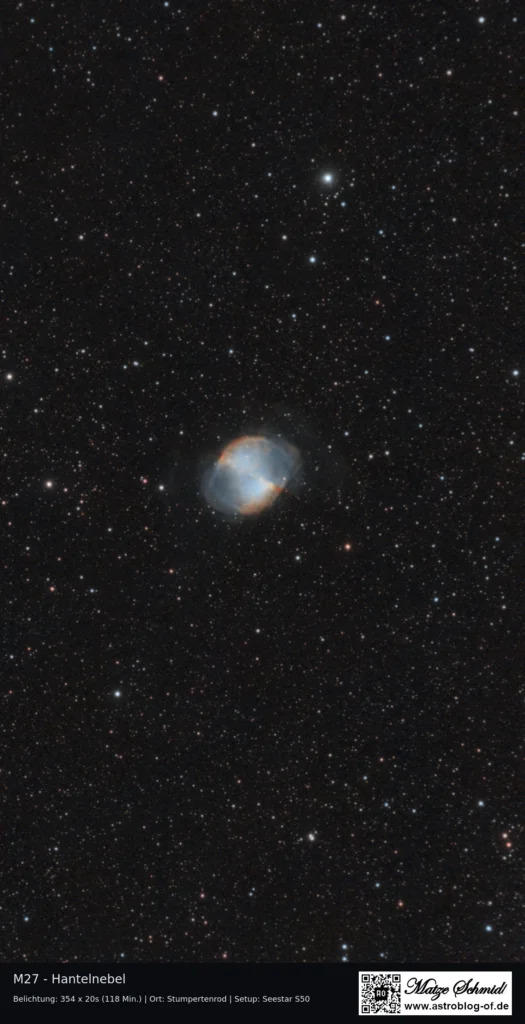
As the night progressed, the sky became more impressive. The Milky Way's band was clearly visible, and the fainter stars of various constellations stood out beautifully. In the constellation Fox, I observed the Dumbbell Nebula M27, which was distinctly visible against the background, showcasing its characteristic shape.
After M27, we moved on to the Blinking Nebula NGC 6826 in Cygnus. This planetary nebula can easily be overlooked at low magnification, often revealing itself only when one lightly bypasses the central star. However, with medium magnification, it becomes strikingly apparent, and I find it endlessly fascinating.
A less spectacular but still visually appealing object we observed was the globular cluster NGC 6229 in Hercules. This small cluster, along with two other stars, formed a neat triangle, earning it the nickname "Mouse Face"—the two stars represent the eyes, while the globular cluster forms the nose. The conditions were excellent, allowing us to see the "face" quite clearly. We then followed up with the globular cluster M92, which ranks among the most beautiful of its kind, alongside M13.
Exploring Galaxies and Facing Challenges
Our next target was the open cluster M103 in Cassiopeia. We then attempted to observe the Whirlpool Galaxy M51 in Canes Venatici, which was somewhat obscured due to light pollution in that region. After this slightly disappointing view of M51, we were pleased to return to another globular cluster: M56 in Lyra.
In the constellation Cygnus, we encountered NGC 7027, also known as the "Magic Carpet," which presented a challenge due to its small size, requiring high magnification for visibility. With my 5.5 mm eyepiece, I achieved a magnification of 323 times on my Dobson telescope, allowing me to spot it easily.
After this more demanding observation, we shifted to a lovely open cluster: M29, also found in Cygnus and nicknamed the "Cooling Tower."
Insights Through Different Telescopes
As the night wore on, I decided to peer through some neighboring telescopes. I had the opportunity to observe the Ring Nebula and M13 through a 25-inch Dobson. Unfortunately, I still couldn't see the central star in the Ring Nebula. However, I was treated to a new discovery in M13: some darker areas resembling a propeller or the interior of a Mercedes star. The owner of the 25-inch Dobson also shared that he measured the sky brightness, which was an impressive 21.2, indicating exceptional viewing conditions that night.
As the sky began to brighten, I packed up my gear and crawled into my tent, satisfied with the night’s observations.