Precise Measurement of Chemical Abundances Near a Supermassive Black Hole
An international team of astrophysicists has achieved the first detailed measurement of heavy element abundances around the supermassive black hole in the Compass Galaxy, revealing insights into supernova contributions and chemical evolution.
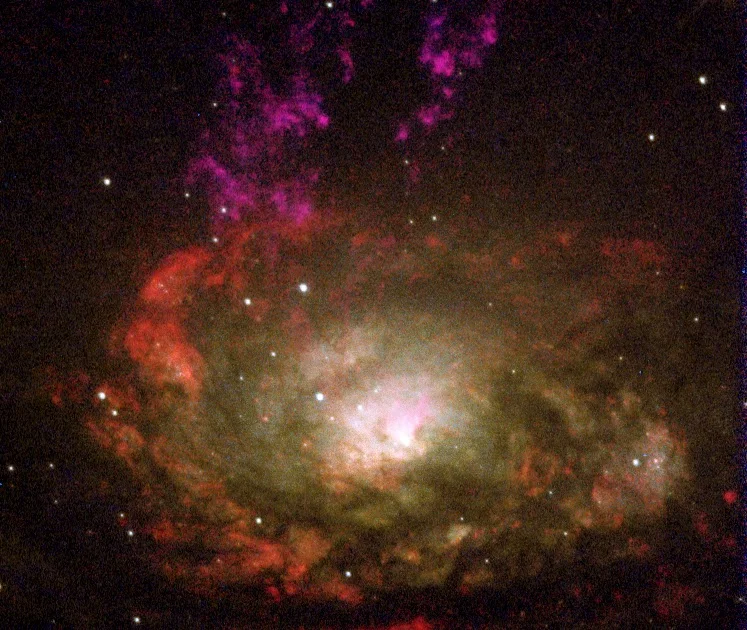
A team of international astrophysicists has achieved a groundbreaking feat by providing the first detailed measurement of the distribution of several heavy element abundances in the vicinity of the supermassive black hole located in the Compass Galaxy. This analysis sheds light on the relative contributions of different types of supernovae that have chemically enriched the area surrounding the black hole. The findings of this study have been published in Nature Astronomy.
The distribution of elemental abundances serves as a fundamental indicator for tracing the history of metal production and injection into astrophysical systems. It retains a record of past contributions from supernovae, primarily divided between thermonuclear Type Ia supernovae and core-collapse supernovae (Types II, Ib, and Ic). The heavy elements synthesized during these stellar explosions are gradually dispersed into the interstellar and intergalactic medium, polluting the primordial gas from the Big Bang, which was initially dominated by hydrogen and helium.
Observations of X-rays from hot intra-cluster gas in galaxy clusters indicate that, when integrating the enrichment over cosmic time, the metal abundance ratios are close to solar values. Current nucleosynthesis models can reproduce these distributions by assuming contributions of about 20% from Type Ia supernovae and 80% from core-collapse supernovae.
However, directly probing the chemical composition at the very heart of galaxies—a critical region for understanding their evolutionary history and the growth of supermassive black holes—has long posed a significant observational challenge. In the ultraviolet, optical, and near-infrared domains, the metallic abundances of galaxies hosting active nuclei are typically inferred from the intensity ratios of nebular emission lines, utilizing photoionization models. These models describe the interaction of ultraviolet and optical radiation with the surrounding gas, but their results are highly dependent on assumptions regarding gas density distribution, the shape of the ionizing continuum, and the degree of element depletion onto dust grains. Such dependencies introduce substantial systematic uncertainties.

In contrast, the interaction of X-rays with matter is physically simpler and allows for a nearly direct study of all components of the medium, including gas and dust. When a high-energy X-ray photon is absorbed by an atom through the photoelectric effect, a fluorescence line is emitted. The intensity of this line is directly proportional to the abundance of the corresponding element in the irradiated medium. Diagnostics based on the observed fluorescence lines in the X-ray spectrum reflected by the material surrounding a supermassive black hole thus provide a robust method for estimating elemental abundances in the active nuclei of galaxies.
Recording these lines, which are often weak and closely spaced in energy, requires exceptional spectral resolution. Currently, the benchmark instrument for this type of study is the Resolve microcalorimeter spectrometer, which is onboard the recently launched Japanese space telescope XRISM. Thanks to its unprecedented energy resolution, Resolve enables the detection and precise measurement of fluorescence lines from elements that were previously inaccessible.
In this context, astrophysicists from the XRISM international collaboration targeted the Compass Galaxy, a nearby spiral galaxy (approximately 4.2 Mpc away) that hosts the closest known Seyfert 2 nucleus. Previous X-ray observations indicated that its active nucleus is heavily obscured by a significant amount of material, making it an ideal laboratory for studying the obscuring torus and its X-ray reflection spectrum.
The Compass Galaxy was observed with XRISM from February 8 to 12, 2024, for a total exposure time of 309 ks. These observations were complemented by nearly simultaneous campaigns with the NuSTAR and XMM-Newton telescopes to extend the spectral coverage into higher energies and improve spatial resolution below 10 keV. The overall spectrum obtained with XRISM covers an area of approximately 3′ × 3′ centered on the galactic nucleus and reveals numerous emission lines associated with various elements, including argon, calcium, chromium, manganese, iron, and nickel.
The analysis of the broadened and modified Kα fluorescence line profile of iron, affected by Compton scattering, indicates that the emitting material is cold, dense, and highly metal-enriched. Its location at a distance greater than 0.024 pc from the supermassive black hole is consistent with the region of the dusty torus. Comparing the intensities of the fluorescence lines of different elements relative to that of iron highlights argon/iron and calcium/iron ratios that are below solar values, while the nickel/iron ratio appears to be overabundant.
Based on this distribution of abundances, researchers were able to constrain the optimal combination of supernovae responsible for the observed chemical enrichment, utilizing the fact that different types of supernovae produce heavy elements in distinct proportions. They conclude that there is a dominant contribution (approximately 92%) from core-collapse supernovae originating from stars with masses below 20 solar masses, compared to about 8% from Type Ia supernovae.
These findings have significant implications for our understanding of the co-evolution of galaxies and their supermassive black holes, as well as for the physics of core-collapse supernovae. The measured chemical composition suggests that the supermassive black hole in the Compass Galaxy is accreting gas that has recently been enriched by Type II supernovae, rather than ancient gas dominated by the products of Type Ia supernovae. This observation remains compatible with the “inside-out” galactic formation scenarios, provided that the gas in the torus region (≲ 20 pc) is continuously replenished by the external galactic disk, thereby replacing the ancient gas.
Furthermore, the coexistence of nuclear star formation activity and an active nucleus is consistent with models in which supernovae contribute to obscuring the central engine. The high metallicity of the nuclear regions also underscores the potential role of active galactic nuclei feedback as a mechanism for chemical enrichment on a galactic and even intergalactic scale.
The identification of an upper mass limit (≈ 20 M⊙) for progenitors of core-collapse supernovae in the central region of the galaxy also sheds crucial light on the fate of massive stars. Some theories predict that stars with several tens of solar masses may collapse directly into black holes or produce very faint supernovae without ejecting heavy elements. Although a few candidates for such direct collapses have been identified in the local Universe, their overall contribution remains debated. The absence of chemical signatures associated with supernovae from stars over 20 M⊙ in the XRISM spectra reinforces the hypothesis of direct collapses or failed explosions in metal-rich environments, unless the formation of very massive stars is intrinsically inhibited there.
This scenario could also provide a resolution to the “red supergiant problem,” which refers to the observed absence of core-collapse supernovae from red supergiant stars with masses exceeding about 18 M⊙ in the local Universe, despite the confirmed existence of such stars.
Finally, the direct collapse of massive stars in metal-enriched environments has significant consequences for the overall history of cosmic nucleosynthesis. In the primordial Universe, characterized by low metallicity, very massive stars could explode as supernovae and produce substantial amounts of α-elements. This contrast between different cosmic epochs may explain why the integrated abundance ratios observed today in most galaxy clusters are close to solar values.