Observe Solar Spots with Your Eclipse Glasses!
Discover how to observe sunspots using eclipse glasses, a method that allows for safe viewing of solar activity beyond just eclipses.
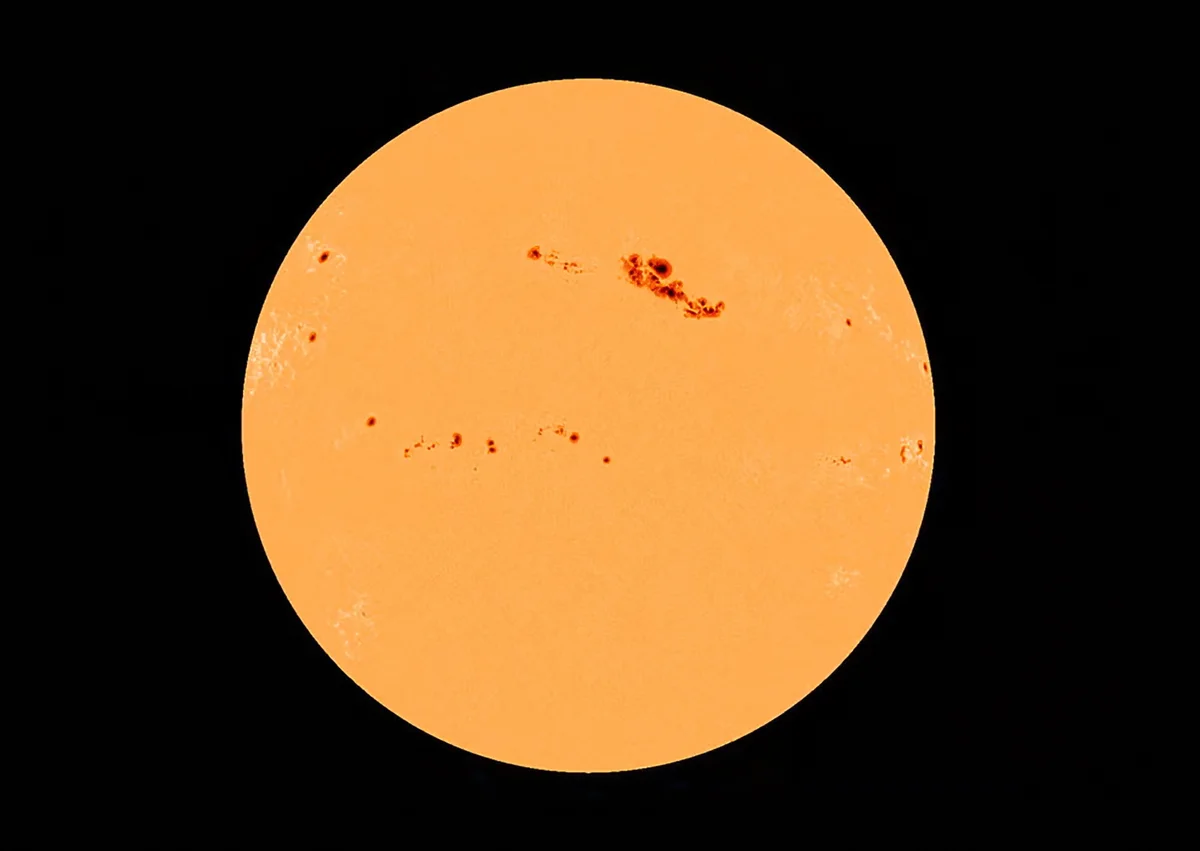
The Sun is not a flawless celestial body. The first astronomer to notice this was the German Johannes Fabricius in 1610, when he observed the Sun low on the horizon, its light heavily filtered by the Earth's atmosphere. He spotted dark spots that appeared to shift from day to day.
Today, anyone can replicate this observation without waiting for sunrise or sunset. By using special solar eclipse glasses, like those provided in issues 54 and 55 of Ciel & Espace, as well as in the August-September 2026 issue, you can safely view the Sun during the day.
Viewing the Solar Disk
Eclipse glasses are not solely intended for observing the Sun during partial eclipses; they primarily protect the eyes from harmful infrared and ultraviolet radiation. This protection is crucial to prevent irreversible retinal burns, which are particularly dangerous due to their painless nature. However, outside of eclipse events, people rarely think to observe the Sun. If you've attempted this, you might have noticed that aside from its uniform disk, which appears similar in size to the Moon, there isn’t much to capture your attention.
Watch for Exceptional Spots
Nevertheless, it can be worthwhile to don your eclipse glasses regularly and scrutinize the Sun's surface. During periods of heightened solar activity, which has been the case in recent years, it is not unusual to spot sunspots, just as Fabricius did.
From June 26 to July 4, 2026, a group of sunspots cataloged by professional astronomers as AR 4478 was so extensive that it was easily visible to the naked eye through eclipse glasses. Notably, the largest of these spots measured about 77,000 kilometers in diameter, which is six times the diameter of Earth!
Such sunspots are indeed rare, but they can occur during periods of solar activity that follow an 11-year cycle. The peak of the current cycle was reached at the end of 2024, yet the tangled magnetic field lines responsible for sunspot formation are still in flux. Therefore, don’t wait for an eclipse to inspect the Sun's surface with your special glasses; you might catch one of these fascinating occurrences. To stay informed, you can check the daily status of the solar surface by viewing images from the Solar Dynamics Observatory (SDO) on the Spaceweather.com website!
Happy solar observations and enjoy the upcoming eclipse!