Novel Measurement of Instantaneous Power from a Black Hole Jet
Researchers have measured the instantaneous power of the jet from the black hole Cygnus X-1, revealing insights into the interactions between the jet and the stellar wind from its companion star.
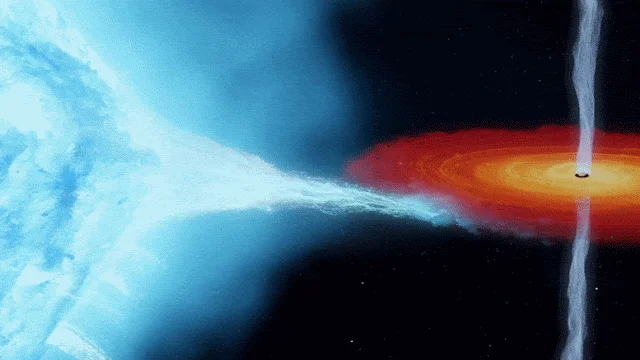
In a groundbreaking study published in Nature Astronomy, researchers have successfully measured the instantaneous power of the jet emanating from the black hole Cygnus X-1, utilizing 18 years of high-resolution radio imaging. This study reveals a curvature in the jets, influenced by the stellar wind from its companion star in the binary system, marking a significant advancement in understanding black hole jets.

Understanding how the accretion of supermassive black holes influences galaxy evolution is a primary goal in the study of relativistic jets. These jets create large-scale shocks, introduce cosmic rays and magnetic fields into the interstellar medium, and generate turbulence, all while clearing vast cavities in the gas surrounding galaxy groups and clusters. However, a fundamental challenge in modeling kinetic feedback arises from the lack of instantaneous measurements of jet power, which would provide insight into the fraction of energy accreted that is converted into kinetic energy.
Traditionally, astrophysicists have relied on time-averaged estimates of jet power derived from calorimetry of the bubbles inflated by the jets. This method averages the total kinetic power emitted by a jet over its entire lifespan, which far exceeds the timescale of variability in the accretion flow. Consequently, calorimetric measurements fail to accurately calibrate the instantaneous kinetic feedback efficiency of accreting black holes, a critical parameter for large-scale structure formation models. This limitation has prompted researchers to devise a method for measuring the instantaneous power of jets from an accreting black hole, leading them to focus on nearby stellar-mass black hole binary systems.
The X-ray binary systems provide a unique opportunity to measure the instantaneous power of jets due to the predicted interactions between the stellar wind from the companion star and the jets. In such systems, the black hole accretes material from the powerful stellar wind of its massive companion star. As the jets are emitted from the black hole, they propagate through this wind, which can deflect the jets, resulting in a helical trajectory influenced by the orbital motion of the black hole. The overall path of the jet is determined by the relative momenta of the wind and the jet. Thus, if the wind parameters are known, it becomes possible to measure the instantaneous power, speed, geometry, and any misalignment between the jet and the binary system.
Located at a distance of 2.22 kpc, the high-mass X-ray binary system Cygnus X-1 hosts a black hole with a mass of 21.2 ± 2.2 M⊙, orbiting a spectral type O supergiant companion with a mass of 40.6 M⊙ every 5.6 days. The black hole feeds on the stellar wind, which has a mass loss rate of (2.57 ± 0.05) × 10⁻⁶ M⊙ per year. A stable jet is emitted near the black hole and can be resolved through high-resolution angular radio observations using Very Long Baseline Interferometry (VLBI). Initial VLBI observations of Cygnus X-1 in the late 1990s only detected the approaching jet, amplified by the Doppler effect. A more sensitive VLBI campaign in 2016 successfully identified the corresponding receding jet for the first time, revealing a similar position angle to that of the approaching jet in the sky plane. The low eccentricity of the binary system (e = 0.019 ± 0.003) and its low spatial velocity suggest a relatively weak initial kick during the formation of the black hole, indicating that the jet axis should be well-aligned with the binary's orbital plane. However, recent findings have indicated significant misalignment between the jet axis and the orbital angular momentum vector.
Furthermore, calorimetry of Cygnus X-1 has anchored numerous observational scaling relations for black holes, such as the jet power relative to radio luminosity across the mass spectrum of black holes, underscoring the importance of measuring the instantaneous power of the Cygnus X-1 jet.
S. Prabu and colleagues from Curtin University, Australia, reanalyzed data from the 2016 campaign. Their examination of individual VLBA and EVN images showed that the observed position angles of the approaching and receding jets varied with orbital phase. They confirmed, using archival data, that the variation in the position angle of the approaching jet was reproducible, with deviations dependent on the orbital phase relative to a constant median position angle over 18 years. Additionally, an independent analysis of the jets indicated that the approaching and receding jets bent in different directions, deviated from the position of the donor star.
The observed difference in position angles cannot be simply explained by precession of the jet axis; however, it fits naturally within a scenario where the jets are deflected by the stellar wind. Prabu and his team proposed an analytical model of jet curvature induced by the wind, balancing the wind's momentum flux with the lateral momentum flux of the jet while accounting for orbital motion to predict the overall helical structure of the jet. This physics-based model also considered non-ballistic effects due to the helical jet's thrust against the wind. By fitting this analytical model, evaluated numerically, to the measured jet structure, they were able to infer the properties of the jet at launch.
The simultaneous fitting of six epochs of VLBA observations from 2016 allowed for the first time the determination of instantaneous jet power in an accreting black hole, along with the jet speed. It had initially been proposed that the black hole in Cygnus X-1 formed through direct collapse of a very massive star. In the absence of a supernova kick, the black hole's rotation axis should be well aligned with its orbital angular momentum. However, recent detection of strong polarization in the X-rays emitted by the system indicates a significant misalignment of about 18° along the line of sight. Conversely, a study of frequency-dependent phase shifts observed in the radio light curves suggested a misalignment of 20 to 30° in the sky plane. Given these conflicting results, Prabu and colleagues explored the impact of misalignment on the calculated jet trajectories.
In the presence of a misaligned jet, one would expect strong asymmetrical non-ballistic wind-jet interactions near the base of the jet. Regardless of the misalignment geometry, the approaching jet would propagate toward the star (where the wind is denser) at a specific orbital phase, while the receding jet would do so half an orbit later. A significant misalignment (≳ 10°) would lead to strong asymmetric curvature of the approaching and receding jets due to the differing non-ballistic forces exerted by the wind; however, the researchers did not observe this phenomenon.
Nevertheless, they adjusted the jet trajectories with additional parameters to account for the misalignment between the jet axis and the orbital axis, allowing them to determine the jet power: 10³⁷.3 erg.s⁻¹, the jet speed: 68% of the speed of light, and an optimal misalignment of 5.2°. However, to account for potential systematic errors due to averaging the jet trajectories over a 12-hour observation, the astrophysicists adopted a conservative upper limit of 8.2° on the misalignment between the jet and the binary system.
Such a small jet-orbit misalignment implies that other explanations are needed for the strong X-ray polarization observed by IXPE (Imaging X-ray Polarimetry Explorer), such as the presence of a relativistic flow in the corona. The radio phase shifts could be explained by the helical structure of the jet, created by the jet curvature and the orbital motion of the black hole. This small misalignment is also consistent with the low eccentricity and low peculiar velocity of the system, as well as with theoretical predictions regarding the formation of such massive black holes.
Although the jet power estimates from the three physical models (without misalignment, with misalignment, and with misalignment and non-conical jet) are consistent at a level of 1 σ and are relatively insensitive to uncertainties in the mass loss rate of the donor star's wind, Prabu and his collaborators favor the jet power estimate derived from the model allowing both misalignment and non-conical jet geometry. This model, which relies on the fewest assumptions, suggests that over the lifetime of the X-ray binary system Cygnus X-1, the total kinetic feedback from the jets would be on the order of several times 10⁵⁰ ergs, comparable to that of a supernova.
The researchers note that the instantaneous jet power they measured is in excellent agreement with the average jet power of 4 to 14 × 10³⁶ ergs s⁻¹ obtained for Cygnus X-1 through calorimetry. The striking similarity between the bolometric luminosity of hard X-rays from Cygnus X-1 and the jet power measurement by Prabu et al. validates the commonly assumed conversion fractions of accretion into jet energy used in typical galaxy formation simulations.
By providing a precise and instantaneous measurement of the power of the jets from Cygnus X-1, the researchers have validated the calorimetry approach previously used to calibrate the fraction of accretion energy converted into the kinetic energy of jets. The strong concordance between instantaneous and average jet powers suggests the long-term stability of jets produced by inefficient hard X-ray accretion flows. This validation enhances confidence in the broader applicability of calorimetric techniques to estimate jet power in other black hole systems, including active galactic nuclei, regardless of their specific accretion regime.
This unprecedented measurement of the instantaneous conversion fraction of accretion energy into jet energy significantly supports the energy budget assumed for accreting black holes in large-scale cosmological simulations.