New Candidate Gravitational Arc Discovered in MACS J0308.9+2645 Using James Webb Data
Astrophysicist Homer Dávila Gutierrez has discovered a new gravitational arc candidate named A1 in the MACS J0308.9+2645 galaxy cluster using data from the James Webb Space Telescope.
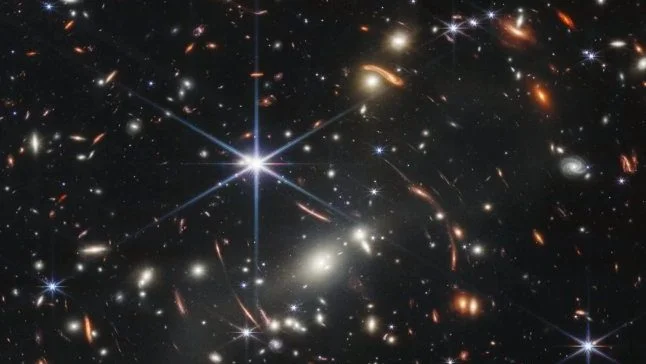
Astrophysicist Homer Dávila Gutierrez has identified a new, uncatalogued gravitational arc candidate in the galaxy cluster MACS J0308.9+2645 by analyzing public data from the James Webb Space Telescope (JWST). This object, referred to as A1, is estimated to have an initial photometric redshift around 4.4.
Since its launch in 2022, the JWST has provided extraordinary images of the cosmos, surpassing even the detailed captures from the Hubble Space Telescope. Among its most photogenic targets is the galaxy cluster MACS J0308.9+2645, a deep field previously imaged by Hubble, known for its gravitational lenses that reveal distant galaxies whose light has been traveling to us for approximately 13 billion years.
These gravitational lenses distort and amplify the light from background galaxies, causing them to appear as elongated arcs in the images. While sifting through these arcs, Gutierrez, who is also the founder and director of SKYCR.ORG, discovered a new candidate, A1, which had not been included in any previously published catalogs.
Identification of Candidate A1
Gutierrez analyzed archival data from Webb's Near-Infrared Camera (NIRCam), collected during the observational program GO 5293. By examining 54 public NIRCam fields and evaluating over 1,500 potential candidates, he isolated one that stood out: A1, characterized by a highly elongated shape and a consistent orientation with the gravitational lensing effect produced by the cluster.
The object is particularly intriguing due to three key factors: its geometry, featuring a pronounced axis ratio and a tangential alignment relative to the center of the cluster; its brightness, which exceeds that of other similar sources in the vicinity; and its complete absence from major astronomical catalogs, including those specific to the cluster and large international databases.
Reevaluation of Redshift
An initial multiband photometric analysis conducted with the EAZY tool had placed A1 at a photometric redshift of around 4.4, suggesting it existed within the first billion years of the universe. Subsequent analyses, carried out in collaboration with the GO-5293 program team and based on corrected photometry, provided a more reliable estimate of approximately z ≈ 1.4, corresponding to about 9 billion years ago. This time frame, while still ancient, is less extreme than the initial hypothesis.
According to the current interpretation shared by lensing experts on the observational team, A1 appears to be a single, elongated lens image that is moderately amplified by the cluster's gravity, but not replicated in multiple images. Its position, approximately 51 arc seconds from the X center of the cluster, aligns with this scenario.
A Second Candidate and a Broader Lesson
The investigation also uncovered a second object, A2, which is fainter and less defined, and its nature remains to be clarified using the same verification process applied to A1. This case highlights how Webb's public archive still harbors discoveries accessible to independent researchers, as well as the potential for initial estimates from automatic catalog photometry to be misleading, underscoring the necessity for cross-verification and direct comparison with original observational teams.