Hot Winds from Galaxy M82: A Breakthrough in Galactic Dynamics
Astronomers have measured the velocity of hot gas ejected from the core of the starburst galaxy M82, offering new insights into galactic winds and star formation processes.
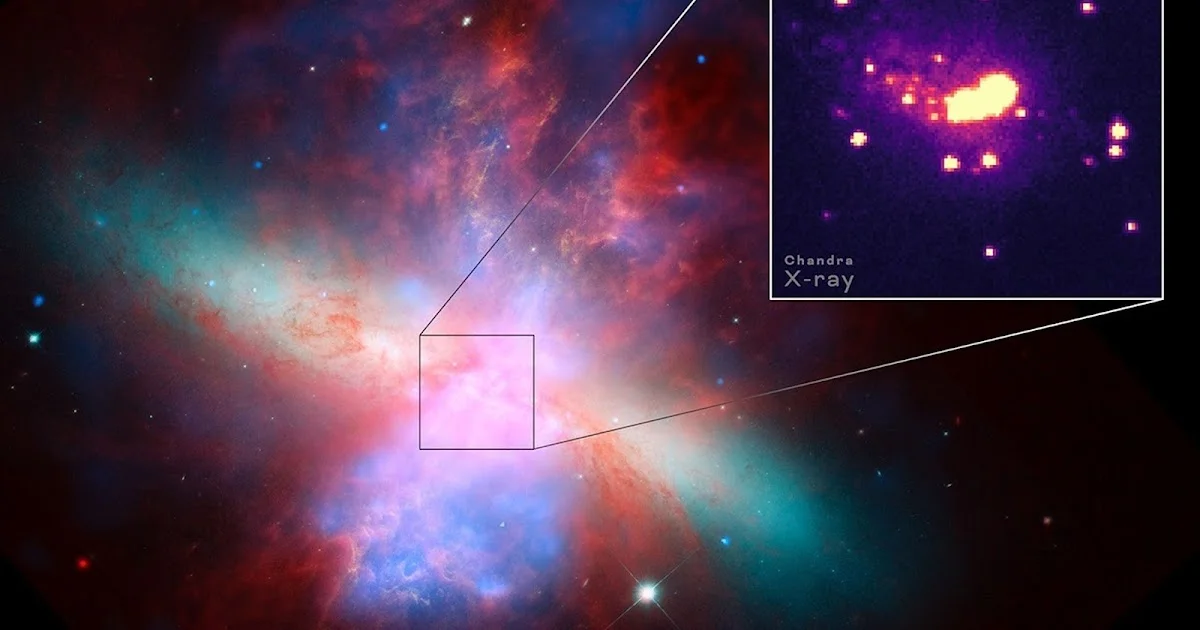
Astronomers have made a significant advancement in understanding galactic winds by directly measuring the velocity of extremely hot gas ejected from the core of the nearby galaxy M82, known for its intense star formation activity. These findings, published in the journal Nature, enhance our comprehension of the mechanisms driving galactic winds in starburst galaxies.

The observations indicate that this hot wind serves as the primary driver for a larger, cooler galactic wind already documented, which extends broadly around the galaxy. The measurements were facilitated by the Resolve instrument, a high-resolution spectrometer linked to the XRISM (X-ray Imaging and Spectroscopy Mission), which specializes in X-ray observations.
Traditional theoretical models suggest that in starburst galaxies like M82, the energy released from the formation of massive stars and supernovae significantly heats the central interstellar gas. This gas, reaching extreme temperatures, experiences substantial thermal pressure that propels it outward as a galactic wind. Previously, the lack of direct measurements of hot gas velocities hindered rigorous testing of these models. However, XRISM data now show that these velocities exceed some predictions, allowing the gas to escape the galaxy's gravitational potential.
Located approximately 12 million light-years from Earth in the constellation Ursa Major, M82, often referred to as the “Cigar Galaxy” due to its elongated shape, forms stars at a rate about ten times greater than that of the Milky Way. This makes it an ideal laboratory for studying the feedback processes between star formation and the interstellar medium.

M82 is also known for its extensive cold wind, comprising gas and dust that stretches nearly 40,000 light-years. This cold wind has been observed by several space telescopes, including Hubble, Chandra, Spitzer, and Webb, to better understand the relationship between central star activity and large-scale material expulsion.
A crucial aspect of these studies involves cosmic rays—charged particles moving at relativistic speeds. Accelerated by the same violent phenomena responsible for galactic winds, they could contribute to the overall pressure exerted on the gas, aiding its expulsion from the galaxy.
Utilizing the high spectral resolution of XRISM, Erin Boettcher from the University of Maryland and her colleagues analyzed the X-ray emission lines of highly ionized iron present in M82's central gas. The intensity of these lines allowed them to estimate the gas temperature at around 25 million kelvins, consistent with theoretical predictions. At such temperatures, the thermal pressure becomes sufficient to accelerate the gas outward, akin to gas flow driven by pressure gradients.
The hot wind's velocity was gauged from the broadening of spectral lines, an effect linked to the Doppler shift. The rapid motion of the gas, moving toward and away from the observer, broadens the observed lines. This analysis reveals that the wind's speed is slightly higher than anticipated. Coupled with the high temperature of the gas, this speed is adequate to explain the driving force behind the cold wind, without necessitating a dominant contribution from cosmic rays, although they may play a secondary role.
Boettcher and her team estimate that M82's center expels a mass of gas equivalent to about seven solar masses annually. However, they found that a portion of this material does not appear to directly contribute to the observed cold wind. Only around 60% of the hot wind's power is needed to accelerate the cold gas to the observed velocities, suggesting that approximately 40% of the hot wind, or 3 solar masses per year, could escape. Assuming a steady state, around 30 million solar masses of this gas could have reached the intergalactic medium over the past 10 million years since the onset of recent starburst activity.

This gas is enriched with metals from star formation. Furthermore, the hot wind fluid transports much of the thermal energy from the multiphase flow. This indicates that up to one-third of the total thermal energy carried by the multiphase wind also reaches the intergalactic medium during the hot phase. M82 thus exemplifies moderate heating and chemical enrichment of the intergalactic medium by a starburst galaxy wind with a low redshift. The XRISM observations of M82 provide a unique opportunity to compare starburst galaxy models with precise observational data.
The advent of high-resolution X-ray spectroscopy will enable statistical measurements of the mass, metals, and energy associated with the hottest phases of starburst galaxy winds, thereby refining our understanding of the baryonic cycle and galactic feedback processes in models describing galaxy evolution in the universe.