Exploring the Trifid Nebula: A Deep-Sky Gem
Fotografia della Nebulosa Trifida (Messier 20) nella costellazione del Sagittario, notizie storiche su osservazioni del passato, informazioni fisiche e osservazioni visuali amatoriali
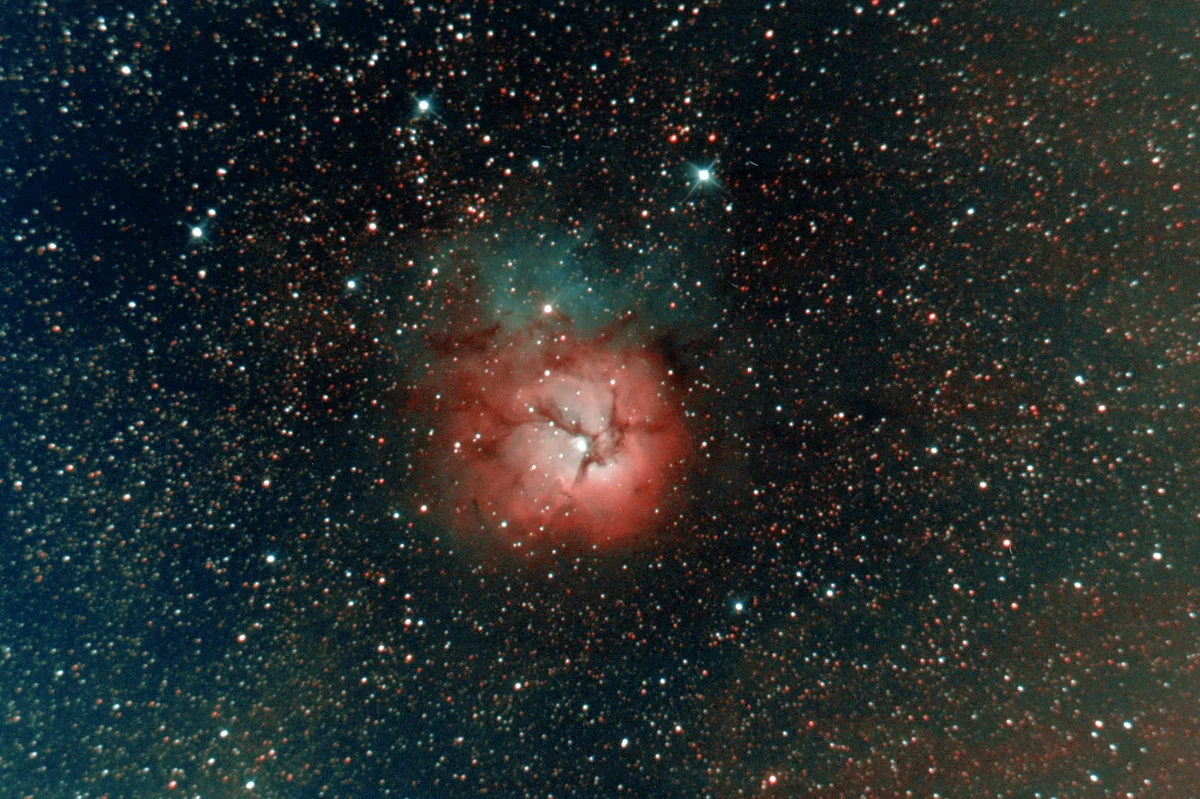
After a significant hiatus, I am resuming my astronomy blog, inspired by the astrophotographic images I capture from my terrace in Sassari. With the summer season approaching, a plethora of stunning celestial objects are emerging on the horizon, including nebulae and star clusters, while the Milky Way will dominate the night sky throughout the summer months. Among the first images of this new season is one of the Trifid Nebula (Messier 20), taken on May 20, 2022. This image was created by combining a series of 15 exposures, each lasting five minutes, totaling one hour and fifteen minutes of integration time. The equipment used included a 250mm Skywatcher Newtonian telescope at f/5 (with a focal length of 1,250mm), a QHY8L CCD camera cooled to -15°C, a Skywatcher EQ6 Pro mount, guiding through a 60/700 refractor telescope, and a CMOS ASI 120MC camera. The acquisition software was APT (Astro Photography Tool), with automatic guiding via PHD2. Image processing was conducted with Maxim DL4, which included calibration using 30 Bias, 20 Dark, and 25 Flat frames, followed by post-processing in Photoshop. All of this was achieved from my home terrace in Sassari, despite significant interference from heavy light pollution. I hope you enjoy the result.
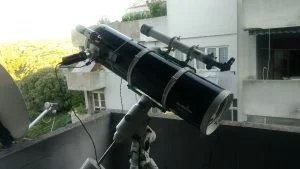
The Skywatcher 250/1250 (f/5) telescope used to capture the image of the Trifid Nebula, along with other images. The CCD camera QHY8L can be seen at the top of the tube in place of the eyepiece.
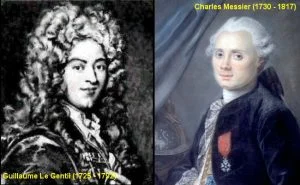
From a technical standpoint, the Trifid Nebula is one of the most beautiful deep-sky objects in the night sky. Located within the constellation Sagittarius, a region rich in spectacular nebular objects, it also hosts the center of our galaxy, the Milky Way. The nebula was likely first identified by the French astronomer Guillaume Le Gentil in 1747, considered one of the most unfortunate astronomers in history. It was independently rediscovered by fellow Frenchman Charles Messier in 1764, who included it in his famous catalog of nebular objects as number 20. However, Messier could only perceive a faint cluster of stars, as the delicate nebulosity was beyond the capabilities of his telescope and most others of that era.
The admiral and astronomer William Henry Smyth, using a 15 cm refractor around 1830, identified only a peculiar