Embracing Digital Sovereignty: A Personal Journey
This article explores the author's journey towards digital sovereignty, detailing the steps taken to regain control over digital infrastructure, data, and communication.
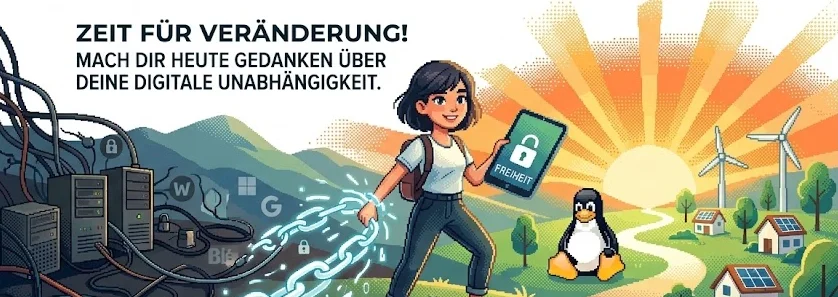
In recent months, I have taken significant steps towards enhancing my digital sovereignty, a topic that has captivated my attention due to its growing importance in today's political and technological landscape. This article will explore the concept of digital sovereignty, its implications, and the personal actions I have undertaken to assert more control over my digital environment.
Understanding Digital Sovereignty
Digital sovereignty refers to the capacity of individuals, organizations, or nations to autonomously manage their digital infrastructure, data, and communications. This concept emphasizes reducing dependencies on external entities and making informed decisions regarding one’s digital landscape.
Practically, this means being aware of where personal data is stored, who has access to it, and under what legal conditions it is processed. Many services we use daily, from social networks to cloud storage and messaging apps, are operated by large multinational corporations. While these services offer convenience, they also create a significant reliance on specific providers.
Digital sovereignty does not necessarily imply abandoning modern digital services. Instead, it encourages conscious decision-making: Which platforms should I use? What alternatives exist? How can I retain control over my data and communications?
In our daily lives, digital sovereignty plays a more critical role than one might initially think. A large portion of our communication, photos, documents, and personal information is stored across various digital services, leading to a dependency on individual companies and their infrastructures.
Therefore, engaging with digital sovereignty involves developing an awareness of how and where our data is stored and exploring ways to maintain control over it. It is not about completely avoiding digital services but rather making informed choices to shape one’s digital environment more autonomously.
In the following sections, I will outline the considerations that have guided me in recent months and the specific steps I have taken to enhance my digital sovereignty.
The First Major Step: Switching from Windows to Linux
For many years, I was a Windows user. However, I increasingly encountered issues following updates, such as features becoming unavailable, files disappearing, or the system failing to boot properly.
Frustrated with these problems, I decided to give Linux another try in December 2021. I had experimented with it before, but previous attempts were often hindered by incompatible software, lack of driver support, or simply the comfort of familiarity.
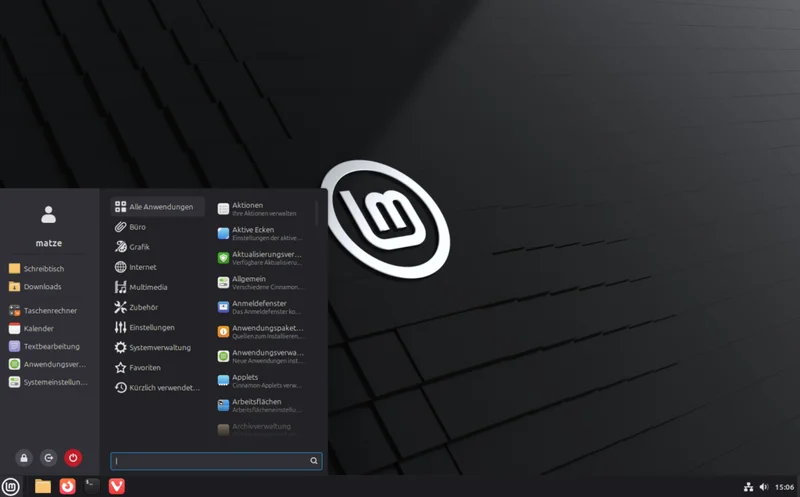
When I first booted Linux Mint after installation, I experienced a genuine wow moment. The system started incredibly quickly, and everything worked seamlessly right away—printers, networks, and other hardware were recognized immediately. LibreOffice and Thunderbird were pre-installed, allowing me to be productive from the get-go.
With LibreOffice, I can accomplish nearly all tasks that I would typically perform with MS Office. The file formats are largely compatible, ensuring smooth collaboration with others. Perhaps the most significant advantage is the absence of a subscription model; the software is free to use. Thunderbird serves as an excellent open-source alternative to Outlook and does not send data to Microsoft, unlike Outlook's current practices.
Linux Mint also comes bundled with Firefox, a browser that is considerably more privacy-conscious than Microsoft Edge or Google Chrome. However, I primarily use Vivaldi, which, while not fully open-source and based on the Chromium engine, offers enhanced privacy features through its integrated ad and tracking blocker, along with extensive customization options. I plan to transition back to Firefox in the long run.
I remained loyal to Linux Mint for several years until curiosity drove me to explore other distributions and their unique features. I have since tested Debian and CachyOS, but I currently use Manjaro, which has been my operating system for several months.
Looking back, switching my operating system was likely the first significant step on my journey toward greater digital independence and freedom.
Developments in Windows That Confirmed My Decision
After switching to Linux, further developments in Windows reinforced my choice. For instance, the introduction of features like Recall, which periodically captures screenshots to reconstruct user activities, fundamentally contradicts my understanding of data minimization and privacy.
Additionally, increasing hardware requirements have rendered older, still capable devices obsolete, and there is a growing mandate for online accounts during the installation and use of the operating system.
These factors have further validated my decision to transition to Linux. I have also supported several individuals in making the switch, receiving overwhelmingly positive feedback—everyone continues to use Linux.
Cloud Storage: Seeking Greater Control Over My Data
Another area that prompted me to reflect was cloud storage. Many large providers increasingly utilize stored data for analysis and training AI systems. Even if this data is often anonymized, it creates discomfort knowing that personal documents or photos could be included in such evaluations.
Consequently, I have opted for self-hosted solutions. I now use Nextcloud as the central platform for my data, running my own Nextcloud instance on a Synology NAS at home. Although the NAS's operating system is proprietary, I at least have physical control over my drives and data.
Currently, a backup of my data is still encrypted on Google Drive, but I plan to transition it to Ionos. With its Germany-based servers, this storage complies with strict European data protection regulations, significantly reducing my dependency on US providers and their legal frameworks (like the Cloud Act). Additionally, my contacts and calendar have migrated to Nextcloud, moving away from Google.
Social Networks and Messengers: Regaining Control Over Communication
In recent years, I have also scrutinized my usage of social networks and messaging apps. Many large platforms heavily rely on algorithms that determine which content is displayed to users. This results in a filtered perception of information, where users do not see the entirety of what their contacts publish.
Moreover, there is extensive data analysis conducted by major platform operators like META, which extends beyond activities on their platforms to include data from numerous third-party websites.
Concerns also arise regarding metadata management in messaging services. Even if content is encrypted, providers can often track who communicates with whom, when, how often, and from where.
Another consideration is the potential political or economic dependency on specific services. In an increasingly tense geopolitical climate, it is plausible that certain services could be restricted or even shut down.
The Alternatives I Use Today
As a result, I have begun using alternative platforms. In the realm of social media, I am now active on Mastodon and Pixelfed, both part of the so-called Fediverse, an open network of interconnected platforms.
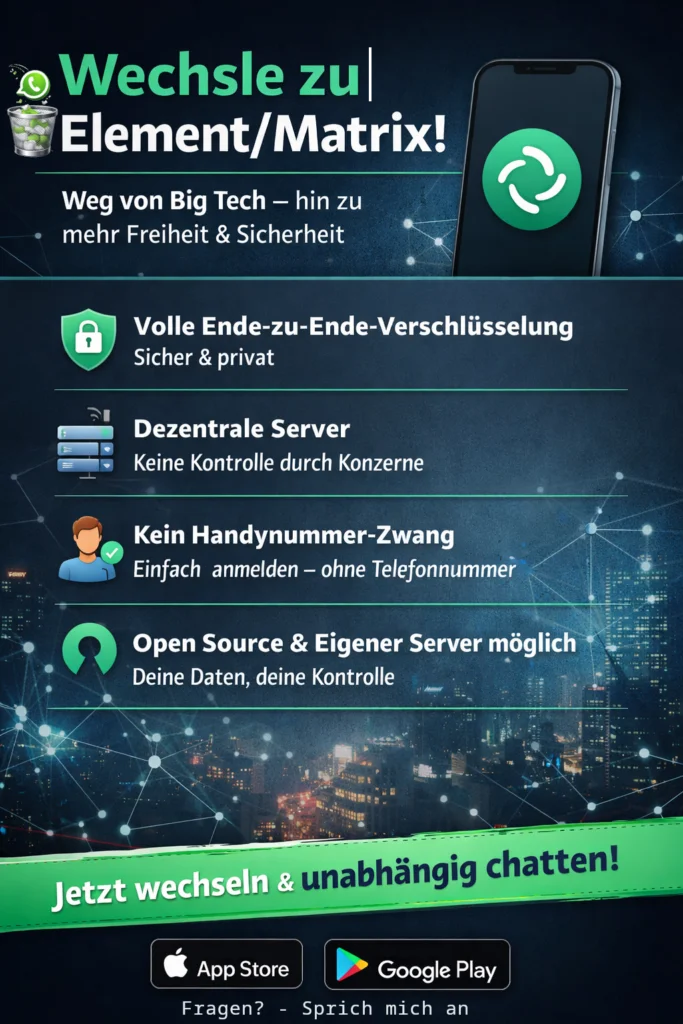
For messaging, I now use Fluffy and Element, which are based on the Matrix protocol. I have also set up my own Matrix server at home.
Currently, I still use a so-called “bridge” to relay messages from WhatsApp and Signal to my Matrix app. This is a convenient transitional solution, but I am aware that as long as the bridge to WhatsApp remains active, the Meta corporation retains insight into the metadata (who communicates with whom and when). Therefore, my long-term goal is to dismantle these bridges and fully transition my communication to open protocols.
Conclusion: Digital Sovereignty is a Process
Engaging with digital sovereignty has led to numerous changes in my technical setup and personal usage behavior over the past months. Many of these steps originated from curiosity but have proven to be meaningful and sustainable over time.