Astronomy of the Lion 'Horoscope'
A crescent moon approaches Regulus in Leo today, revealing insights into ancient depictions and the challenges of interpreting celestial images.
Today, a slender crescent moon will approach the star known as Regulus, often referred to as the "little king," located in the heart of the constellation Leo. While the moon is visible during the day, Regulus will be obscured from the naked eye when the closest approach occurs around 5 PM. The separation between the two celestial bodies will be approximately 1°, too wide to be captured in a telescope and certainly not discernible in daylight conditions. At that time, the constellation will be positioned high in the southern sky.
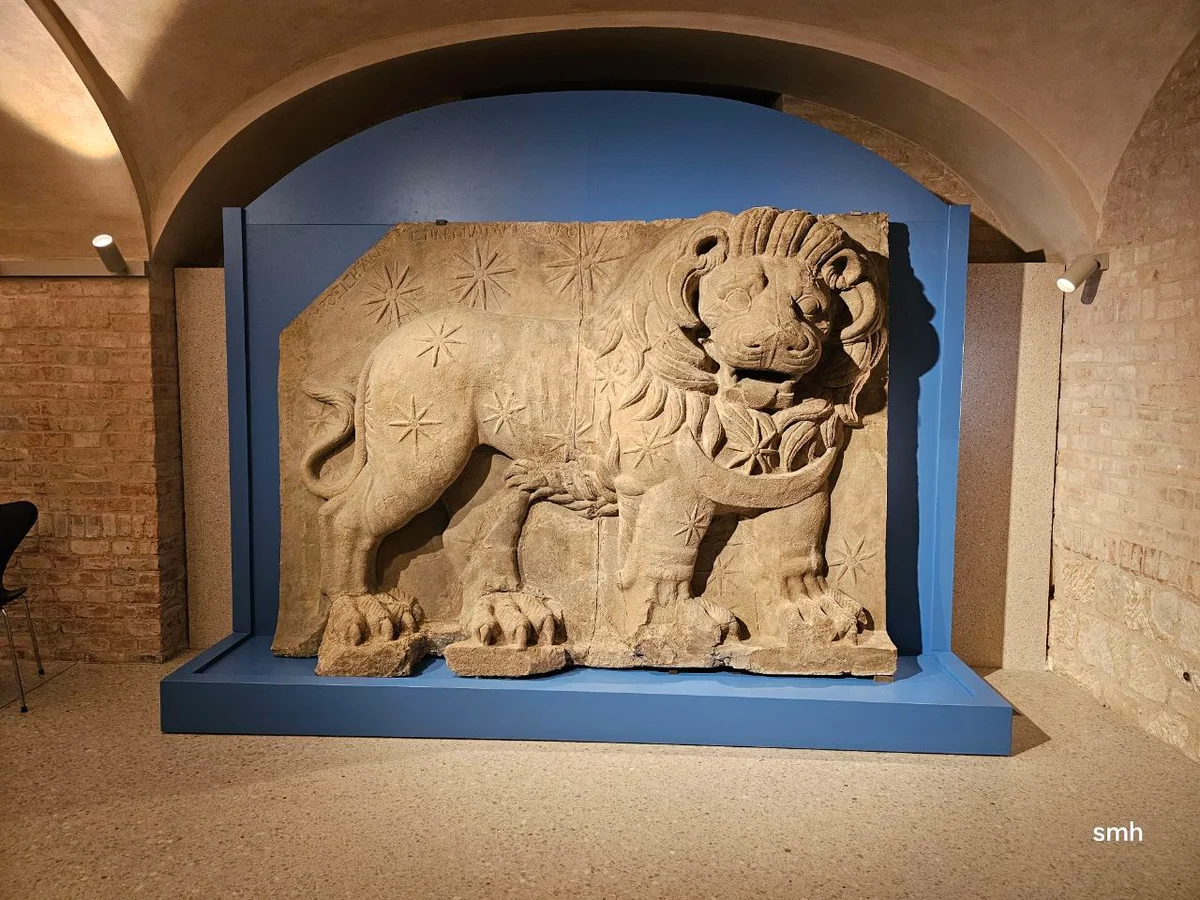
This celestial pairing of the crescent moon and Regulus is reminiscent of depictions found on the famous Lion relief at Nemrut Dağı in southeastern Turkey. Often labeled as the "Lion Horoscope" in literature, this artifact does not actually contain predictions but rather features a lion image adorned with stars. The TOPOI exhibition "Beyond the Horizon" claimed in 2012 that it is the oldest horoscope in the world. However, as a historian, I approach such superlatives with caution, as historical research focuses more on the evolution of knowledge rather than on who or what was "first."
Analogy to the So-Called "Lion Horoscope"
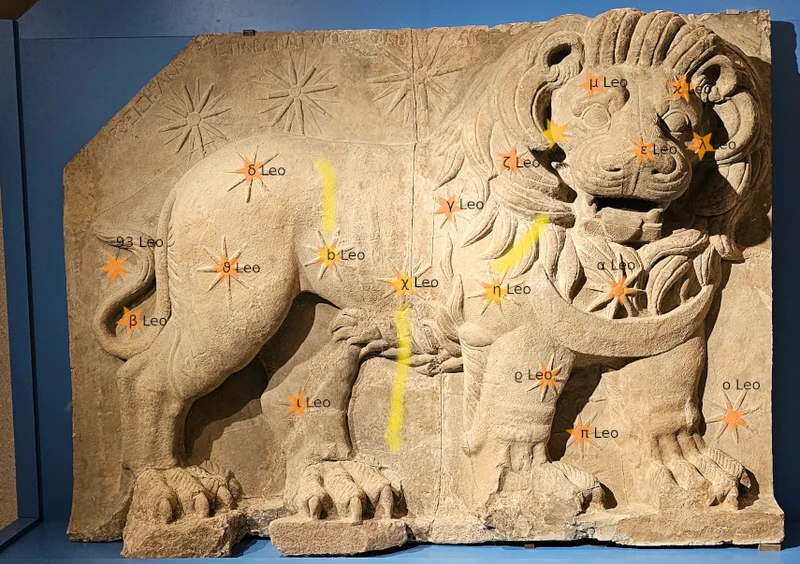
The challenge in interpreting the lion image lies in the representation of three prominent stars, labeled with ornate Greek names for the planets Mercury, Mars, and Jupiter, positioned above the lion's back. This placement is unrealistic, as no sensible planet would appear in such a high northern position in the sky; thus, the depiction is clearly not a star map.
The crescent moon beneath Regulus is a configuration that can occur in June, as seen today. Conversely, when observing the waning moon, a similar alignment will happen this October in the morning sky, featuring two of the three mentioned planets.
The fact that the planets are depicted above the lion, far too north to correspond with actual celestial positions, is a clear indication that this is not a representation of a real constellation. The two stars in the middle (b Leo and chi Leo, along with 93 Leo, where I neglected to draw the bar) may be forgiven for their incorrect latitude, as contemporary astronomical and astrological works often overlooked this aspect. However, the artistic representation of the crescent moon beneath Regulus serves as definitive evidence of artistic license, as (a) the moon is never shaped like a boat beneath the star, since that would require the sun to be in the constellation Hydra (which is not part of the zodiac), and (b) no star would shine through the moon's body, as the moon does not become transparent when it appears as a crescent in the sky.
Moreover, I have never encountered a lion with its hind half of the tail raised in an S-shape while the front part hangs down. It is well-known that astronomers often lack biological insight, as seen in the depiction of the "whale" constellation, so I refrain from passing judgment here.
The "error bars" for the stars, ranging from 3° to 5°, are typically ignored by astrologers when attempting to date this so-called "horoscope." This suggests that the image was created based on visual templates (drawings, sketches) rather than actual celestial observations.
Eratosthenes is sometimes cited as a source, but this cannot be the case, as he mentions one less star in the lion's head than depicted here, indicating that the image contains one too many. While archaeologists usually count curls, we should count stars in this instance.
In short, modern historians may debate which astronomical configuration this image could represent, but the image itself is not dateable! Not even through calculations. The uncertainties surrounding the star positions, along with the moon and planets being depicted symbolically rather than as a star map, are too significant to draw any conclusions from this image.
Thus, the lion of Commagene (like Einstein) sticks out its tongue and laughs at our futile attempts to decipher it!