Astronauts' Perspectives During the 2026 Solar Eclipse
Sophie Adenot will experience the total solar eclipse from the ISS on August 12, 2026, while reflecting on Jean-Pierre Haigneré's historic 1999 eclipse from space.
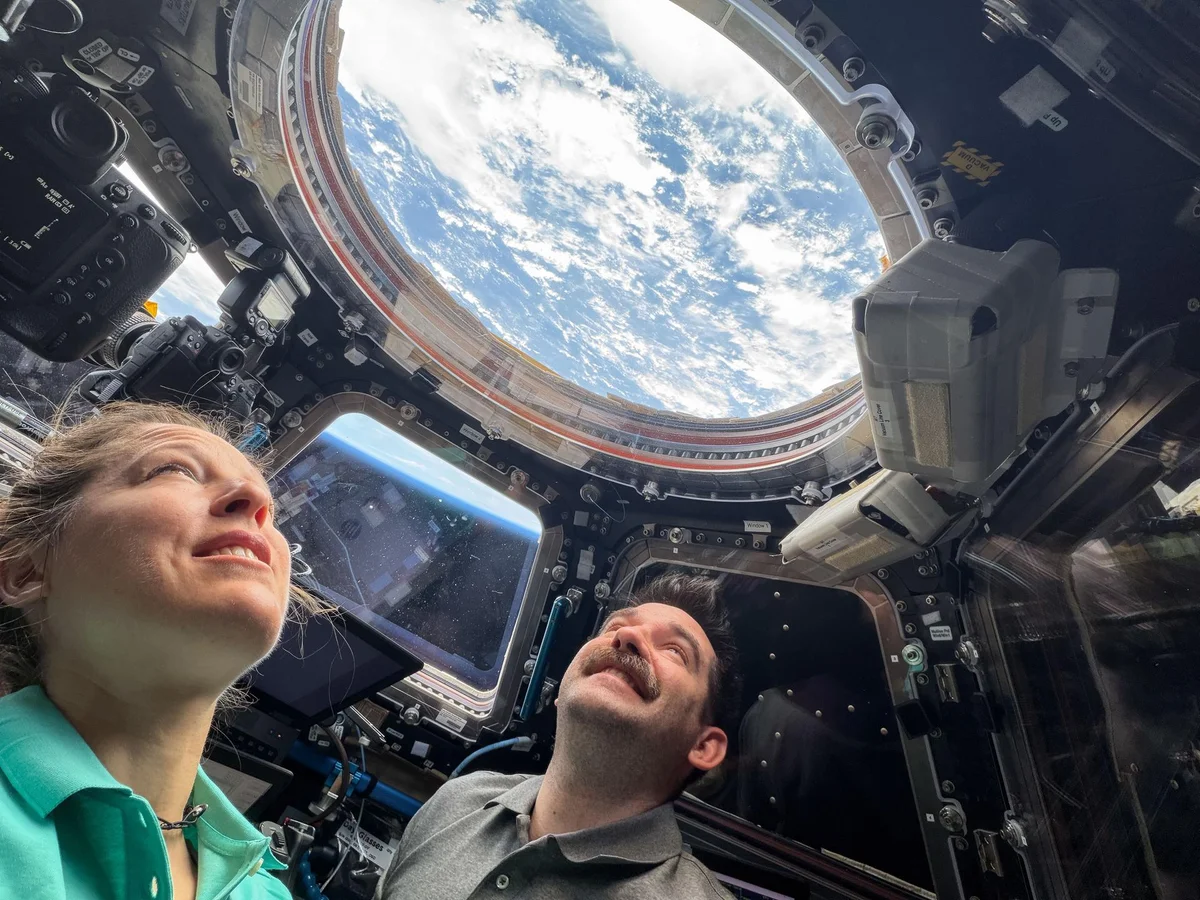
On August 12, 2026, French astronaut Sophie Adenot will be aboard the International Space Station (ISS) during a total solar eclipse. As she prepares for this remarkable event, her predecessor, Jean-Pierre Haigneré, reflects on his own experience witnessing an eclipse from space in 1999, where he captured the first photograph of a total eclipse from orbit.
For those of us on Earth, a solar eclipse is observed from below, but astronauts in space have the unique opportunity to gaze down at our planet as the Moon casts its shadow. This shadow creates a dark spot on the surface, resulting in a total eclipse for everyone beneath it—a brief moment of night during the day.
Seven at the Window
During the upcoming eclipse, Sophie Adenot will be joined by seven other astronauts on the ISS. "I’m very eager to observe it, photograph it, and share this experience with as many people as possible," she shared with Ciel & Espace. However, her ability to fully enjoy this moment may be limited. "I will only know my schedule two to three days before the eclipse, and operational constraints might prevent me from being available during that time," she added. There are ongoing discussions about her potential involvement in a spacewalk around the same date.
To view the Moon’s shadow, Adenot will also have to contend with her fellow crew members. "There are two spots on the ISS that often see congestion: the restrooms and the best viewpoints of Earth," she humorously noted. The prime locations for observing the planet are the Cupola, which features a large seven-windowed dome, and the WORF (World Observation Research Facility), a significant window in the Destiny laboratory module. "On August 12, 2026, we will all want to take photos at the same time. I hope to gain access!" she continued, optimistic that her status as the only European on board might afford her some priority during this celestial event.
Watching a Moving Shadow
Adenot will witness the Moon’s shadow traversing the Earth, beginning in northern Siberia, crossing the North Pole, gliding down the eastern coast of Greenland, passing near Iceland, and finally resting over Spain. This journey will occur at a speed exceeding 2,000 km/h, a pace typically matched only by supersonic aircraft. Yet, from 400 kilometers above, it will appear to drift by leisurely.
Jean-Pierre Haigneré, one of the eleven professional French astronauts, reminisces about the eclipse of August 11, 1999. At that time, he was concluding a mission aboard the Mir space station. Having spent nearly six months in orbit, he had developed a deep appreciation for the beauty of Earth. "I had a perfect sphere beneath my eyes, with its moods and changing colors. It is the only living thing in 99% of a universe that is void," he recalled.
As his mission neared its end, Haigneré found himself less interested in identifying human-made landmarks like the Great Wall of China or Corsica. Instead, he became contemplative. "When I looked at Earth, I no longer used the part of my brain that governs reason, but rather the part that governs emotions. In the end, I was only photographing the clouds," he said, describing them as "makeup for the Earth."
"The Perfect Earth Altered by a Disgrace"
On the day of the 1999 eclipse, clouds obscured parts of northern France, which lay along the path of the Moon's shadow. "I saw the perfect Earth altered by a disgrace, a rough blackness with poorly defined contours," Haigneré recounted. In his travel notes, he compared it to a dirty mark left by the mythological Atlas on the white dress of a beautiful woman, made by a finger smeared with grease.
Historic Photo and Geometric Surprise
Beyond his words, Haigneré made history by capturing what is considered the first photograph of a total eclipse from space. "I used a Nikon F5 film camera with a 300 mm telephoto lens," he reminisced. The task was far more complex than today’s digital photography, as he had to return to Earth with the film in his bag and hope it had survived the harsh radiation of space.
His photograph eventually made headlines in several newspapers in 1999. Before his launch to Mir, Haigneré was unaware that a total eclipse would coincide with the end of his mission. Lacking prior images or accounts from other astronauts, he was taken aback by what he witnessed: "From Earth, eclipses involve perfect geometric shapes. I expected a well-defined disc, but the shadow was diffuse, nuanced, and irregular in color." The blur surrounding the center of the shadow is due to the penumbra, a region that is not completely dark but dimmer as it is illuminated by only a portion of the Sun’s rays.
Now, 27 years and one day later, Sophie Adenot knows what to anticipate. Standing on the shoulders of the astronauts who came before her, she may discover a unique optical detail that has yet to be seen or photographed.