Asteroids of July 2026
Discover the asteroids Melpomene, Flora, and Juno, their characteristics, orbits, and how to observe them in July 2026.
(18) Melpomene
Melpomene was discovered by John Russell Hind on June 24, 1852, at the George Bishop Observatory in London. The name is dedicated to Melpomene, a figure from Greek mythology and the muse of tragedy. It follows an orbit in the inner main belt with a semi-major axis of 2.296 Astronomical Units, an eccentricity of 0.218, and an inclination of 10.13 degrees, completing a revolution around the Sun in 3.48 years.
With an average diameter of about 140 km, Melpomene is an asteroid belonging to the S spectral class. This classification suggests a predominantly rocky surface, rich in silicates, a characteristic that gives the object a moderately high albedo, consistent with bodies of this type. The combination of significant size and good reflectivity often makes it relatively bright near opposition, thus observable even with small-diameter amateur instruments.
From a photometric perspective, the analysis of light curves has determined a rotation period of 11.57 hours. The brightness variations recorded during measurements indicate that the asteroid has a not perfectly spherical shape, consistent with irregular geometry, which is not unusual for an object of this size.
How and When to Observe It
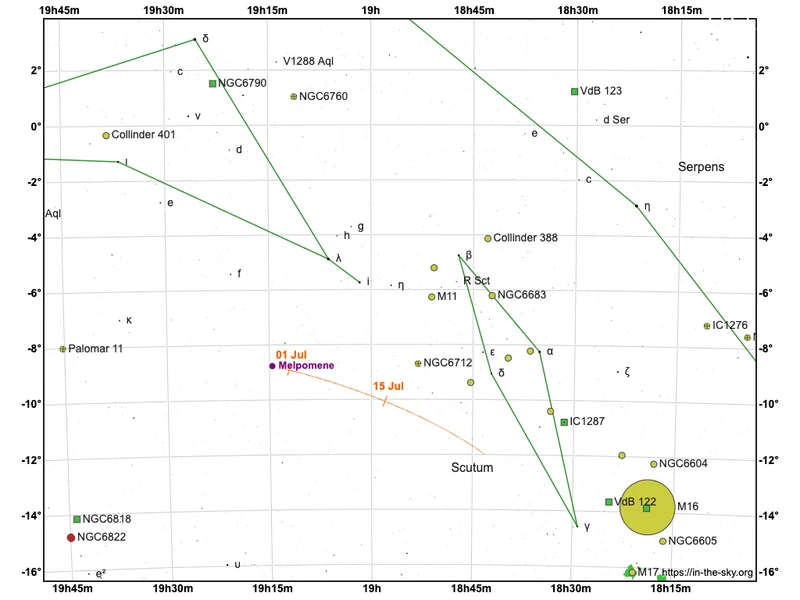
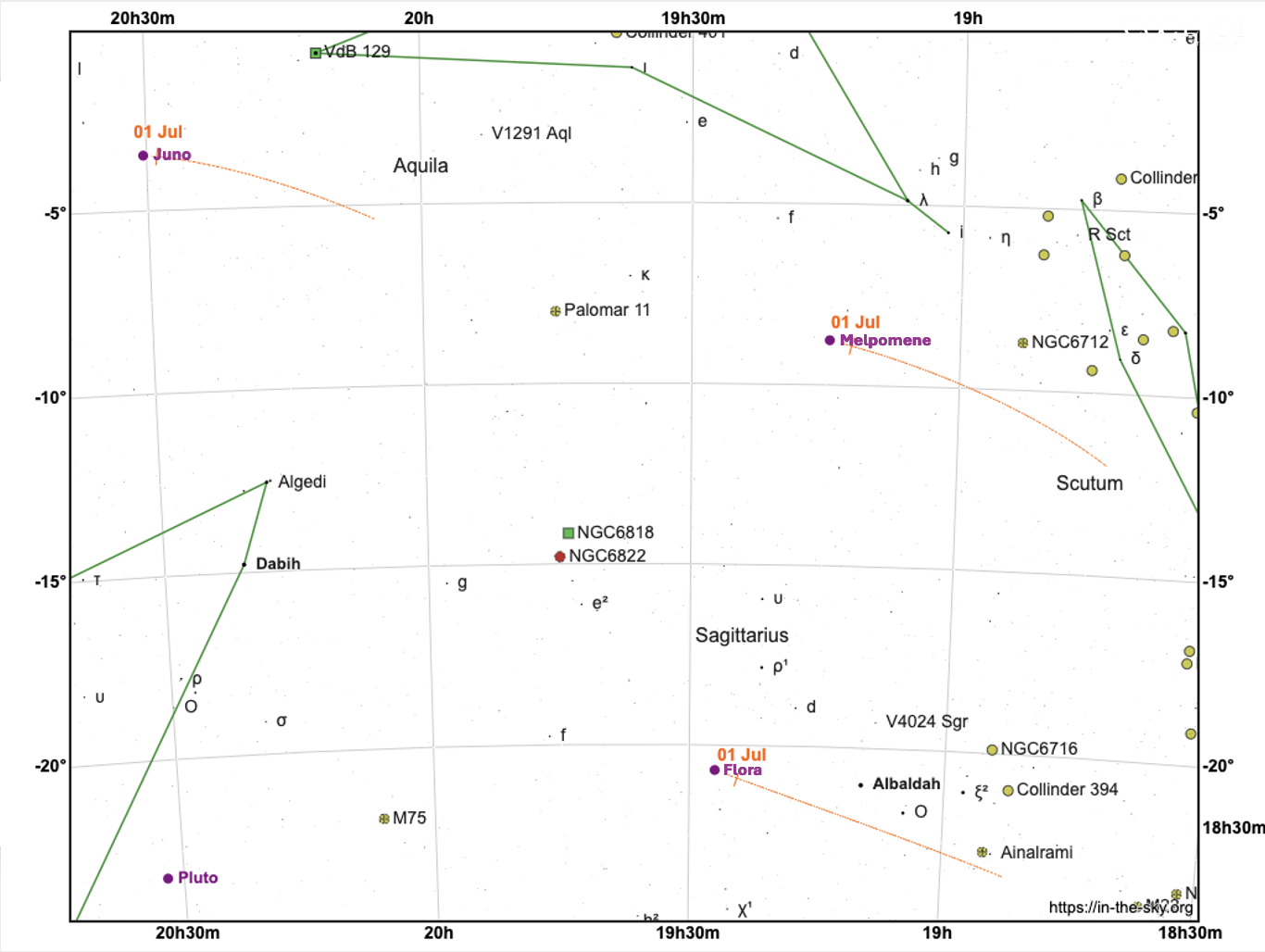
Melpomene will be in opposition on July 8, 2026, at which point it will reach a magnitude of 8.9, located at a distance of about 1.21 Astronomical Units from Earth. Its apparent motion will be about 0.69 arc seconds per minute; exposures of around 3-4 minutes will keep it essentially point-like in most amateur images, while to obtain a trail of motion, we will need to expose or integrate for a longer time, and with 40 minutes of exposure, Melpomene will produce a beautiful luminous trail of about 28 arc seconds.
(8) Flora
Flora was discovered by John Russell Hind on October 18, 1847, at the George Bishop Observatory in London. The name is dedicated to Flora, a figure from Roman mythology associated with blooming and spring. It follows an orbit in the inner main belt with a semi-major axis of 2.20 Astronomical Units, an eccentricity of 0.16, and an inclination of 5.9 degrees, completing a revolution around the Sun in 3.27 years.
With an average diameter of about 148 km, Flora is a large asteroid belonging to the S spectral class. Its spectrum is compatible with a predominantly rocky surface, rich in silicates, a characteristic that gives the object a moderately high albedo. Its dynamic and scientific relevance is notable: Flora is indeed the dominant member of the collisional family that bears its name, a large population of fragments located in the inner region of the main belt. In the most credible estimates, Flora concentrates almost 80% of the mass of the currently identified family and represents the main surviving body of the ancient collisional event that generated the group.
The Flora family is predominantly composed of rocky-type asteroids and constitutes one of the most important populations of the inner main belt. Its position, relatively close to dynamically unstable regions, makes it interesting also in the study of the transfer of small fragments to the orbits of the inner planets.
From a photometric perspective, the analysis of light curves has determined a rotation period of 12.86 hours. The brightness variations recorded during measurements indicate that the asteroid has a not perfectly spherical shape, consistent with irregular geometry, as is often the case for bodies marked by a long collisional history.
How and When to Observe It
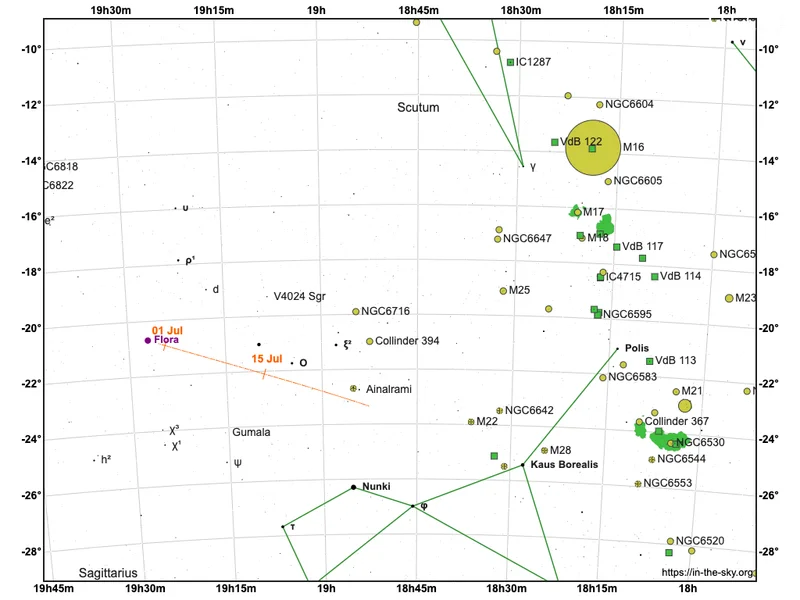
Flora will be in opposition on July 9, 2026, at which point it will reach a magnitude of 9.0, located at a distance of about 1.25 Astronomical Units from Earth. Its apparent motion will be about 0.70 arc seconds per minute, so exposures of around 3-4 minutes will keep it essentially point-like in most amateur images, while to obtain a trail of motion, we will need to expose or integrate for a longer time, and with 40 minutes of exposure, Flora will produce a beautiful luminous trail of about 28 arc seconds.
(3) Juno
Juno was discovered by Karl Ludwig Harding on September 1, 1804, from the Lilienthal Observatory near Bremen. The name is dedicated to Juno, a deity from Roman mythology. It follows an orbit in the central main belt with a semi-major axis of 2.67 Astronomical Units, a rather marked eccentricity of 0.256, and an inclination of 12.99 degrees, completing a revolution around the Sun in 4.36 years.
With an average diameter of about 250 km, Juno is listed among the largest silicate asteroids in the main belt, belonging to the S spectral complex, more precisely to the Sq type in modern taxonomies. This classification indicates a predominantly rocky surface, compatible with silicate materials, which gives the object a moderately high albedo. Being the third asteroid ever discovered, Juno has had significant historical importance in the evolution of the study of minor bodies in the Solar System.
From a photometric perspective, the analysis of light curves has determined a rotation period of 7.21 hours. The measured brightness variations suggest a non-spherical and irregular shape, confirmed by high-resolution observations that have directly shown the asteroid's profile.
How and When to Observe It
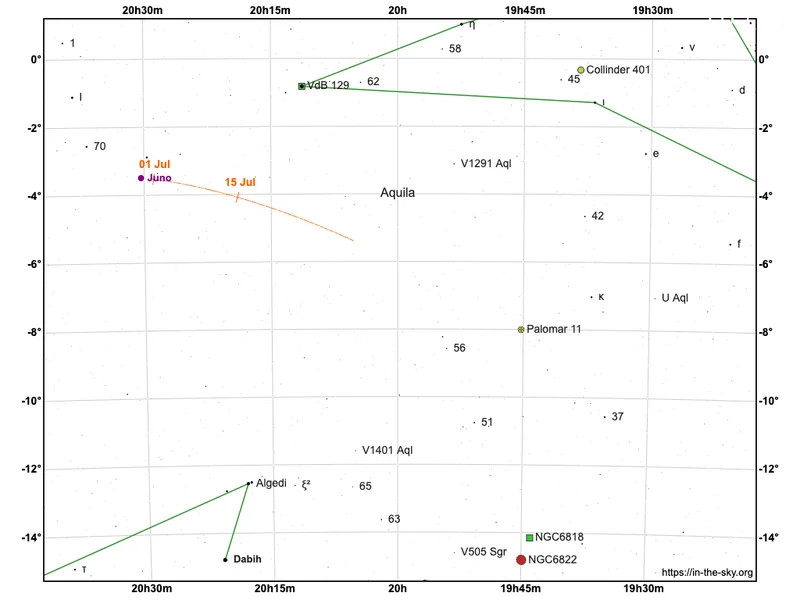
Juno will be in opposition on July 26, 2026, at which point it will reach a magnitude of 9.1, located at a distance of about 1.81 Astronomical Units from Earth. Its apparent motion will be about 0.60 arc seconds per minute, so exposures of around 3-4 minutes will keep it essentially point-like in most amateur images, while to obtain a trail of motion, we will need to expose or integrate for a longer time, and with 40 minutes of exposure, Juno will produce a beautiful luminous streak of about 24 arc seconds.
.