April 26: The Coat Hanger Cluster Cr 399
The Coat Hanger Cluster, or Cr 399, is a prominent and easily identifiable star pattern located in the constellation Vulpecula, resembling a coat hanger.

Object of the Month - The Coat Hanger Cluster Cr 399
Overview
The Coat Hanger Cluster, known as Collinder 399 or simply Cr 399, stands out as one of the most recognizable and easily identifiable star patterns in the night sky.
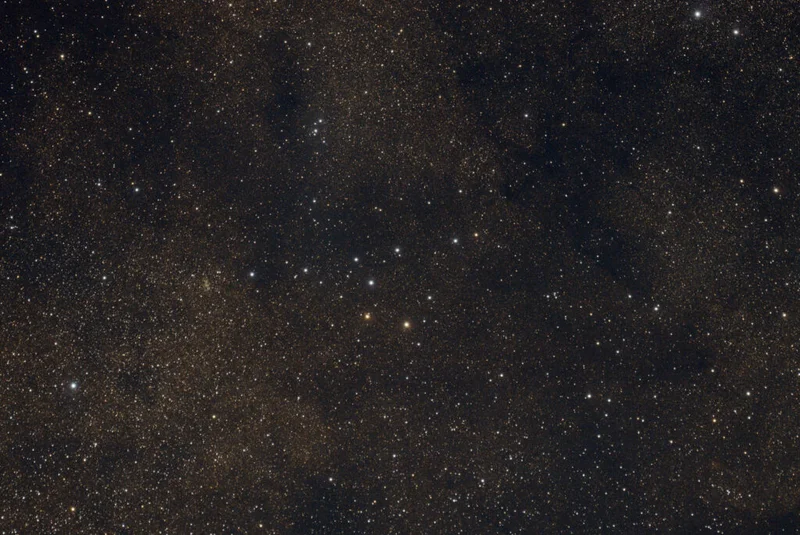
Situated within the inconspicuous constellation of Vulpecula, this cluster derives its name from its striking resemblance to a conventional coat hanger. It features a straight line of six stars that form the base (the coat hanger's rod), while four additional stars create the characteristic hook shape.
Location and Finding
Despite the fact that the constellation Vulpecula does not boast particularly bright stars, Cr 399 is straightforward to locate. It lies precisely between two prominent constellations: Cygnus (the Swan) and Aquila (the Eagle).
To find the Coat Hanger, one can start by identifying the bright star Altair in Aquila. From there, an imaginary line can be drawn towards Albireo (the head of the Swan). Approximately one-third of the way along this line and slightly to the right, just above the small but notable constellation Sagitta (the Arrow), a bright spot becomes visible to the naked eye under dark skies. Through binoculars, the unmistakable shape of the cluster is revealed instantly.
Observation
Cr 399 serves as an exemplary target for binocular observation. The formation stretches across an area of about 1.5 degrees (equivalent to roughly three full moon diameters), making it too large to be fully captured in the field of view of most telescopes at medium magnifications.
In an 8x42 or 10x50 binocular, the Coat Hanger appears particularly vivid. The six stars of the base align almost perfectly, while the hook extends distinctly northward. The stars shine with varying brightness between magnitudes 5 and 7, adding a pleasing dynamism to the object. In larger telescopes equipped with wide-angle eyepieces at low magnifications, the open star cluster NGC 6802 can also be discovered at the eastern end of the base, providing an appealing contrast to the large Coat Hanger formation.
Background and Facts
For a long time, Cr 399 was classified as a true open star cluster. However, modern measurements, particularly from the Hipparcos satellite, have confirmed that it is actually an asterism. This means the stars are at vastly different distances ranging from 200 to 2,300 light-years and are not physically connected. They merely appear to form this pattern from our perspective on Earth.
The formation was named after the Swedish astronomer Per Collinder, who included it in his catalog of open star clusters in 1931.
Conclusion
The Coat Hanger Cluster is a delightful object for casual observation and a highlight for any stargazing night with binoculars. Its simple shape makes it an ideal showcase object for beginners, as the "aha moment" upon first viewing through optics is guaranteed. It serves as a reminder that the sky offers not only distant galaxies and nebulae but also fascinating geometric patterns that arise solely from our viewpoint.
Here is a selection of observation reports featuring the Coat Hanger Cluster:
- Harbach (Rhön) on June 19, 2025
- Vogelsberg on September 7, 2024
- Balkonien on October 16, 2017