Accurately Measuring the Distance of the Outer Arms of the Milky Way: They Are Further Than Expected
A new study using data from X-ray space telescopes XMM-Newton and Chandra reveals that the outer arms of the Milky Way may be about 10% further than previously thought.
A new study, conducted using data from the X-ray space telescopes XMM-Newton (ESA) and Chandra (NASA), extends the size of our Galaxy, revealing that the outer arms may be located about 10% further than previously thought.
The results, published in a paper in the journal Astronomy & Astrophysics, are the outcome of an investigation led by Italian researcher Beatrice Vaia (INAF Milan) as part of her doctoral research.
Despite the progress made in recent decades, particularly thanks to the Gaia space mission (ESA), we still do not have a complete understanding of the structure of the Milky Way.
The reason is that we are immersed in it. Our position does not allow us to have an overview as is the case with other nearby galaxies. Additionally, the gas and dust present in the arms and disk partially obscure our view, denying us access to certain portions, especially with traditional telescopes that operate in visible light. It’s somewhat like trying to reconstruct the shape of your city by only looking out your window; almost certainly, the view would be blocked in some direction, simply by the surrounding buildings.
The methods that scientists usually use to reconstruct the geometry of the Milky Way tend to be less precise when trying to describe the outermost regions, as they rely on models of the Galaxy's rotation, which in turn are affected by uncertainties.
In this new study, however, a more direct geometric method was used, making it less prone to systematic errors.
In particular, by observing in X-rays, the effects of three different Gamma Ray Bursts (GRBs) were analyzed, which are highly energetic flashes of light produced in extreme events such as the death of a massive star or the merger of neutron stars in a binary system. When a gamma-ray burst, originating from a distant galaxy, reaches the Milky Way, it interacts with the dust clouds present in the spiral arms.
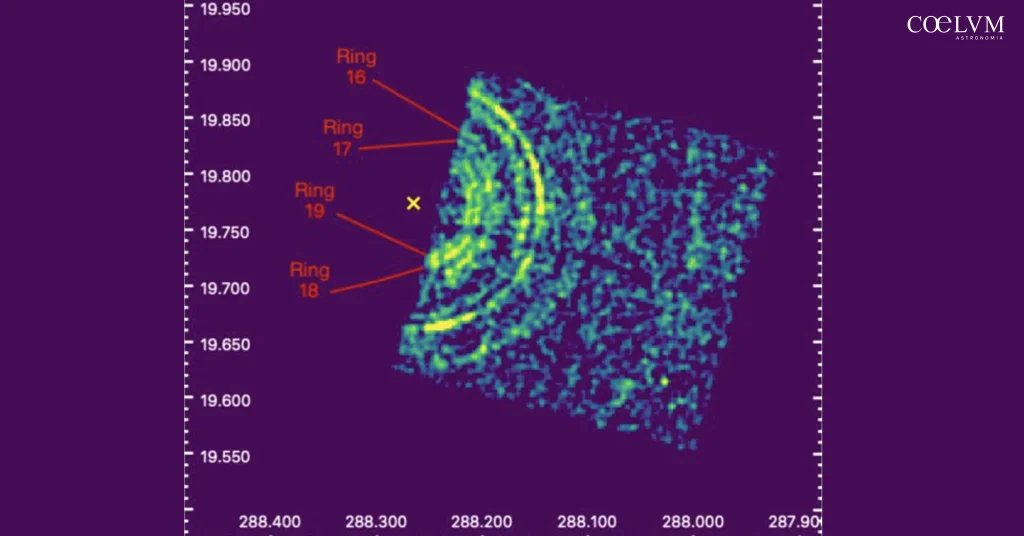
The result is an “echo” of light, which appears as a series of rings in X-rays. The diameter of each ring gives us the distance from Earth; the larger the rings, the closer the dust clouds that generated them are to us.
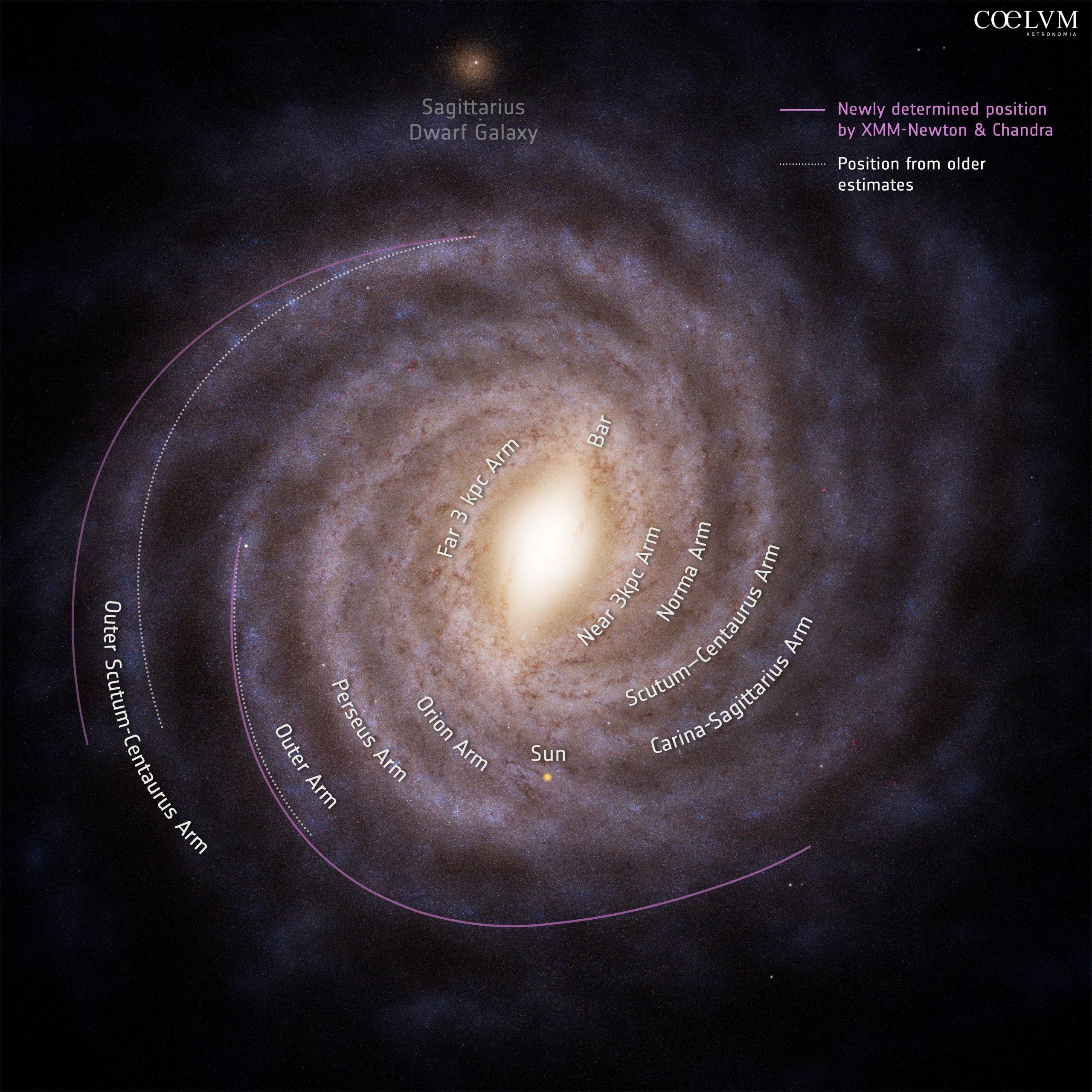
The researchers used three different GRBs to determine the distance of three spiral arms in the Galaxy. In order of distance from the galactic center: the Perseus Arm, the Outer Arm, and the Outer Arm of the Scutum-Centaurus.
It should be noted that this method, while precise, cannot be easily extended systematically to future observations, as observable Gamma Ray Bursts through the galactic plane suitable for this type of analysis are very rare and unpredictable.
Although the difference is small, as emphasized by the authors, studies of this kind are essential for improving our understanding of the shape and size of the Milky Way and thus paving the way for a more accurate assessment of its other properties, such as mass. Step by step, we progress in mapping our corner of the Universe; significant advancements are anticipated in the coming years thanks to the vast amount of data left to us by the Gaia mission – which concluded its scientific observations in January 2025 – and future space missions.
.
Cover image: Image produced by the ACIS (Advanced CCD Imaging Spectrometer) on CHANDRA. The graph (with Right Ascension and Declination on the x and y axes respectively) shows the typical ring structures generated by the interaction between the GRB and the dust clouds. The yellow cross highlights the position of the afterglow due to the GRB; the red labels indicate the positions of rings 16, 17, 18, and 19, produced by clouds at approximately 8, 10, 14, and 19 kpc respectively. Credits: B. Vaia et al.
.
Sources:
- B. Vaia et al., Accurate distances of the Galactic spiral arms from dust-scattered X-ray emission of gamma-ray bursts, A&A (2026)
- XMM-Newton helps revise distance to outer spiral arms | ESA – Science & Exploration
- NASA’s Chandra Examines Milky Way at Arms’ Length | CHANDRA X-ray Observatory