Understanding Radio Astronomy and Its Instruments
Radio astronomy is a vital yet lesser-known branch of astrophysics. This article explores its principles, instruments, and the wonders it reveals about the universe.
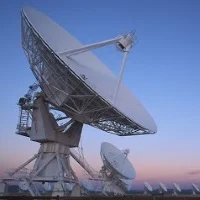
Radio astronomy remains a lesser-known field among amateur astronomers, yet it plays a crucial role in astrophysics. This article delves into the fundamentals of radio astronomy and its significance in the study of the universe.
What is Radio Astronomy?
Radio astronomy involves the exploration of radio waves within the realm of astronomy. Celestial bodies emit radiation in the form of electromagnetic waves due to charged particles. While visible light can be observed with the naked eye or through CCD and CMOS cameras, infrared light is typically detected using specialized cameras. Notably, infrared observations have led to the discovery of the center of our galaxy. The remaining waves fall within the radio spectrum, which can be observed using antennas.
Key Facts about Electromagnetic Waves:
- Frequency refers to the rate of oscillation of a wave, which correlates with its wavelength.
- The amplitude of a wave indicates its power.
- The radio spectrum represents the power of a signal across various observed frequencies.
- Waves cannot penetrate conductive materials.
What Can Be Observed?
The applications of radio astronomy are extensive, utilizing a variety of instruments. The sun is one of the easiest celestial objects to study, requiring only a simple parabolic dish. Other celestial bodies, such as Jupiter and its Great Red Spot, are under constant observation at the Nancay radio astronomy station. Additionally, phenomena like meteor scatter can be detected by listening to radar reflections from meteors entering the thermosphere. Observers can also study galaxies, nebulae, stars, quasars, pulsars, black holes, and much more.
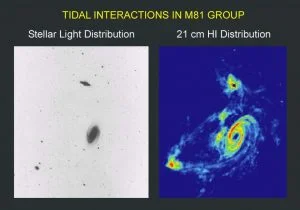
A notable example is the hydrogen atom's emission, known as the 21 cm line at 1420 MHz (1.420 GHz), which can be used to create a map of hydrogen density in the sky.
How Are Observations Made?
Antennas and Parabolic Dishes:
Similar to visual astronomy, radio waves are reflected off a mirror and directed toward a receiver. The larger the mirror, the more powerful the captured waves. A radio telescope's mirror is typically a surface designed to reflect waves, often made of metal. It does not need to be solid; a mesh surface can suffice, acting like a Faraday cage, with the mesh size determined by the frequency band being received. Higher frequencies require finer mesh. The size of an antenna also varies depending on the frequency and sensitivity desired. For instance, my antenna for meteor scatter, a YAGI at 143.05 MHz, measures 2.5 meters long; a similar antenna for a lower frequency would be larger.
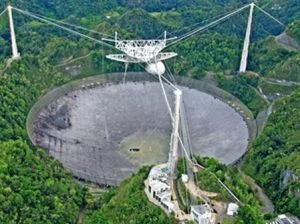
Signals travel from the antenna to the receiver through a coaxial cable, which is shielded to prevent external interference. Numerous types of antennas exist, each with different designs and materials. Their placement is critical, as environmental magnetic fields can affect performance. The world's largest antenna is located at the Arecibo Observatory:
And here is the Nancay radio telescope located in the Centre region:
Receivers and Signal Processing:
Professional Radio Telescopes:
Most professional radio telescopes mix the received signal with a lower frequency signal to facilitate analysis. This is necessary because no electronic method currently exists to analyze very high-frequency signals rapidly. By lowering the frequency, it becomes feasible to use less energy-intensive and more cost-effective electronics. It is important to note that this discussion pertains to data acquisition rather than data processing, meaning the conversion of signals into digital data. An analog-to-digital converter is employed for this purpose.
Once the data is acquired, it is sent to a program that processes and stores it in a human-readable format, such as images or graphs.
Amateur Radio Telescopes:
For amateurs, the simplest method is to use a USB receiver. In recent years, devices like the RTLSDR, available for around €30, have become accessible. These USB keys have an antenna input and are convenient for observing a frequency band, though their acquisition speed is relatively slow compared to professional systems. My meteor scatter setup utilizes an RTLSDR key that captures data every 0.5 seconds, which is slower than a professional installation. Upgrading my system is a future goal once funding is secured.
In terms of processing, the slower receiver generates less data to analyze. In my case, a low-power computer like a Raspberry Pi, running an optimized C program, suffices to handle the processing tasks, which has posed some challenges.
Conclusion:
I hope this article on the discovery of radio telescopes and radio astronomy encourages readers to explore more specialized resources to delve deeper into this fascinating activity. For me, it represents an affordable way to engage in serious applications and enjoy the thrill of amateur research. Happy observing!