Public Participation in the Search for Gravitational Lenses - Spreewald-Spechtler
With the launch of 'Space Warps,' a new citizen science project, the public can actively participate in the search for rare gravitational lenses using data from the Euclid space telescope.
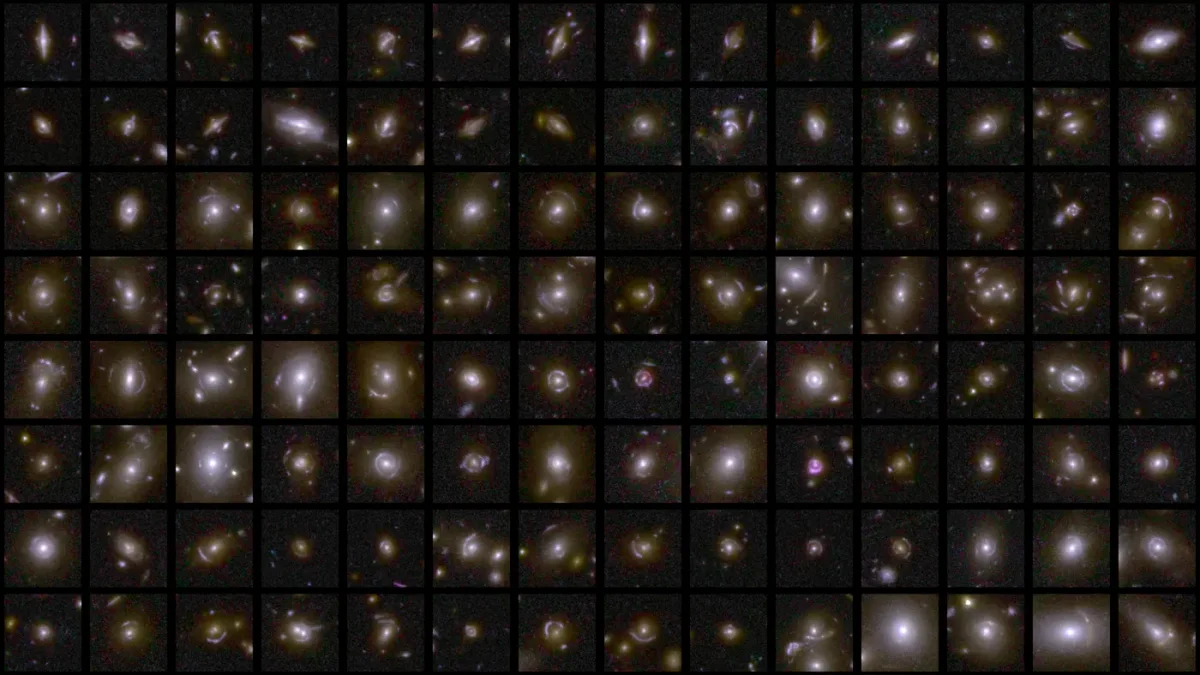
With the launch of "Space Warps," a new citizen science project on the platform Zooniverse, the public can now actively participate in the search for rare and hard-to-detect strong gravitational lenses. The basis for this is unpublished images from the Euclid space telescope of the European Space Agency (ESA). The project aims to provide new insights into dark matter in galaxies and clues about the mysterious dark energy.
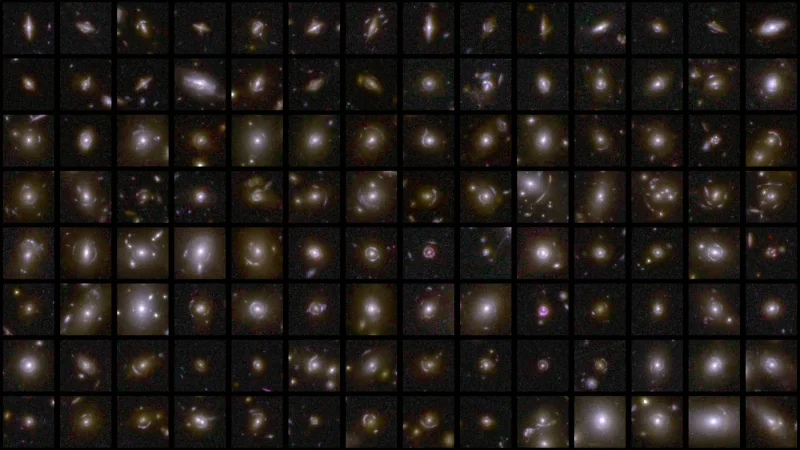
"Warps" in spacetime are not just a theme for science fiction works like Star Trek or the film Interstellar. In reality, we observe this distortion effect of gravity on spacetime in the form of the gravitational lensing effect.
The immense mass of an object—such as a galaxy or a galaxy cluster—distorts the structure of spacetime and bends the light rays from a distant galaxy behind it. This curvature causes the foreground galaxy to act like a magnifying glass.
The light from the background object, which would normally remain obscured, no longer travels in a straight line. Instead, it curves around the intervening mass, often resulting in multiple images, distorted arcs, or even a complete ring—a so-called "Einstein ring," as recently discovered by Euclid.
Strong gravitational lenses are impressive evidence for Einstein's General Theory of Relativity. They illustrate that matter in the universe can function as a natural telescope, making distant objects visible.
The ESA's Euclid space telescope revolutionizes the investigation of strong gravitational lenses through highly sensitive images of vast areas of the sky in unprecedented detail. This is essential for identifying the rare gravitational lenses.
In March 2025, the first publication (Quick Data Release 1, Q1) identified nearly 500 strong lenses between galaxies hidden in just 0.04% of the existing Euclid data. Most of these were previously completely unknown. This first catalog was created through the combined efforts of citizen scientists, machine learning (ML)—a subfield of artificial intelligence (AI)—and professional scientists.
Exclusive Preview of New Euclid Images
As Euclid continues its sky survey and sends approximately 100 GB of data to Earth daily, the ESA and the Euclid consortium again require the support of citizen scientists to identify strong gravitational lenses in a large dataset.
To this end, the Space Warps team has initiated a citizen science project based on new Euclid images. These will be part of the upcoming data release "Data Release 1" (DR1). Since this data is not yet publicly accessible, participating in the project offers an exclusive opportunity to preview the new galaxy images from the telescope.
The focus is on high-quality image data, in which numerous previously unknown strong lenses are hidden. A total of about 300,000 images will be shown, pre-selected using ML algorithms. The criteria for this selection were further refined based on the results of the first Euclid search for strong lenses. These are the most promising candidates from an impressive pool of 72 million galaxies in DR1, classified by ML algorithms. Experts expect this outstanding dataset to lead to the discovery of more than 10,000 new lenses.
Precise Preselection Against the Data Flood
Researchers from Ludwig Maximilian University (LMU) Munich and the Max Planck Institute for Extraterrestrial Physics (MPE) in Garching were significantly involved in the selection of data for the "Space Warps" project. Since Euclid must look through our home galaxy, the Milky Way, to capture distant galaxies, it is necessary to identify and remove interfering objects such as stars, nebulae, and other phenomena from the catalog beforehand. Only then can the targeted search for lens candidates proceed.
"In the first run with the Q1 data, this step reduced 29 million objects to just one million, which were then examined more closely using machine learning and human review," explains LMU and MPE doctoral candidate Leon Ecker. However, together with Maximilian Fabricius, Stella Seitz, and Roberto Saglia (all LMU and MPE), Ecker noted that the initial selection was too broad. Through a refined process, they identified an additional 27,000 candidates. This led to the discovery of 72 more strong gravitational lenses that had remained undetected in the first pass—accounting for 14% of the total findings of nearly 600 objects.
"The current DR1 dataset now directly benefits from these optimizations. This prevents a significant number of potential discoveries from being overlooked," adds Ecker.
What insights do strong gravitational lenses provide?
The Euclid mission investigates the expansion of the universe and the development of its structures over cosmic history. It primarily relies on two methods: the weak gravitational lensing effect and baryonic acoustic oscillations. The goal is to better understand the role of gravity and the nature of dark matter and dark energy.
Strong gravitational lenses also provide valuable contributions to these central questions. For example, they enable precise "weighing" of individual galaxies and galaxy clusters. This reveals the total mass—composed of visible and dark matter—and makes its distribution visible. By studying strong lenses across different cosmic epochs, scientists can track the expansion of the universe and its acceleration. This provides additional insights into the effects of dark energy.
"The success of combining AI with visual verification by volunteers and astronomers has already proven itself in Space Warps. In a first, smaller Euclid search in 2024, hundreds of excellent lens candidates were efficiently identified," explains Aprajita Verma, co-founder of Space Warps and project leader at the University of Oxford.
"The new DR1 dataset is thirty times larger than the original search. Together with our improved algorithms, we expect to find more than 10,000 high-quality lens candidates. That is more than four times the number of lenses that have been found since the discovery of the first gravitational lens nearly 50 years ago."
This dramatic progress is made possible by Euclid. The mission can map vast areas of the sky with unprecedented sharpness—an ideal prerequisite for locating rare objects like strong gravitational lenses.
About Euclid
Euclid was launched in July 2023 and began scientific routine operations on February 14, 2024. The mission aims to unravel the hidden influence of dark matter and dark energy on the visible universe. Over a period of six years, Euclid will investigate the shapes, distances, and movements of billions of galaxies up to a distance of 10 billion light-years.
Euclid is a European mission built and operated by the ESA, with contributions from NASA. The Euclid consortium—comprising more than 2,000 scientists from 300 institutions across 15 European countries, as well as the USA, Canada, and Japan—is responsible for providing the scientific instruments and analyzing the scientific data. ESA selected Thales Alenia Space as the prime contractor for building the satellite and its service module; Airbus Defence and Space was tasked with developing the payload module, including the telescope. NASA provided the detectors for the Near Infrared Spectrometer and Photometer (NISP). Euclid is a medium-class mission within ESA's Cosmic Vision program.
The German Contribution
Euclid was launched in July 2023 and began its routine scientific observations on February 14, 2024. It is a European mission built and operated by the European Space Agency (ESA), with contributions from its member states and NASA. The Euclid consortium—comprising more than 2,000 scientists from 300 institutions in 15 European countries, the USA, Canada, and Japan—is responsible for providing the scientific instruments and scientific data analysis. ESA selected Thales Alenia Space as the prime contractor for building the satellite and its service module, while Airbus Defence and Space was tasked with developing the payload module, including the telescope. NASA provided the detectors for the Near Infrared Spectrometer and Photometer (NISP).
From Germany, the Max Planck Institute for Astronomy in Heidelberg, the Max Planck Institute for Extraterrestrial Physics in Garching, Ludwig Maximilian University Munich, the University of Bonn, Ruhr University Bochum, Bielefeld University, and the German Aerospace Center (DLR) in Bonn are involved in the Euclid project.
The German Aerospace Center at DLR coordinates the German ESA contributions and supports the participating German research institutes with 60 million euros from the National Space Program.
With around 21%, Germany is the most significant contributor to ESA's science program.
NM
Link to the press release from MPIA