CARMELO METEOR: May 2026 Bulletin of Radio Meteors
Explore the May 2026 bulletin of the CARMELo network, focusing on the Eta Aquarids meteor shower, data analysis, and instrumentation used in radio meteor detection.
Curated by the CARMELo network
(Cheap Amateur Radio Meteor Echoes Logger)
Mariasole Maglione (CARMELo Network and GAV, Vicentine Astrophile Group)
Lorenzo Barbieri (CARMELo Network and AAB, Bolognese Astrophile Association)
Table of Contents
- May Bulletin
-
- Introduction
- May Data
- The Eta Aquarids
- Construction of the RZHR
- Instrumentation
- The CARMELo Network
-
Introduction
May is the month of the Eta Aquarids. The peak, expected on May 7, was not particularly pronounced. To analyze the activity of the meteor shower, we utilized a new algorithm that attempts to separate the contribution of the Eta Aquarids from that of sporadic meteors.
May Data
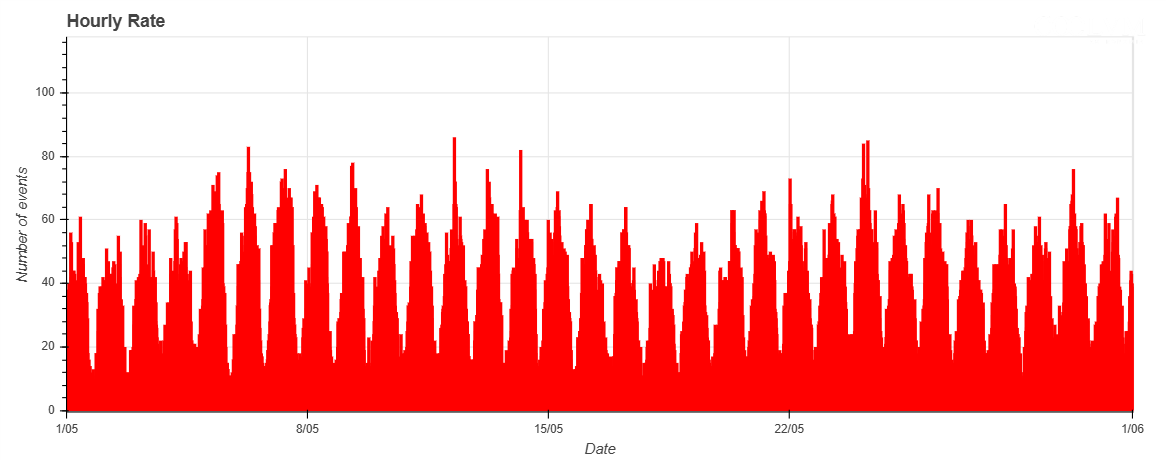
The following graphs are taken from this page: the x-axis represents time, expressed in UT (Universal Time) or Solar Longitude, and the y-axis represents the hourly rate, calculated as the total number of events recorded by the network in the hour divided by the number of active receivers. The temporal resolution is 15 minutes.
The Eta Aquarids
The Eta Aquarids (ETA) are an active meteor shower each year from mid-April to late May, with a visibility peak around May 6. Although less spectacular than more well-known showers, the Eta Aquarids hold particular importance due to their origin: the fragments that compose them come from the famous Halley's Comet, which also gives rise to the Orionids in October (1).
The radiant of the shower is located in the constellation Aquarius, near the star Eta Aquarii, from which it derives its name. In our latitudes, this point rises just before dawn, around 3:30 AM, making the last hours of the night the most suitable time for observation and detection. Due to the low position of the radiant on the horizon, the number of meteors visible in Italy is generally limited to about 30–40 per hour. In southern regions, where the radiant rises much higher above the horizon, the shower offers a much more intense display, with zenithal hourly rates (ZHR) that can exceed 50–60 meteors per hour.
The Eta Aquarids are also distinguished by the high speed of the meteors, which can reach over 66 km/s. This makes their trails in the sky particularly bright and persistent, with streaks that sometimes last for several seconds. The peak of activity is usually in the first week of May, with this year’s peak expected on May 7.
Construction of the RZHR
With RZHR (Radio Zenithal Hourly Rate), we refer to the hourly rate of radio meteors from a shower, calculated by processing data from meteor scatter receivers.
This tool allows us to make a significant leap in quality, moving away from the qualitative analysis we have conducted so far by working exclusively on graphs and transitioning to the direct processing of data from our database. To achieve this, we developed a Python script with the help of the “Cursor” tool, an AI-powered code editor created by Anysphere. This support proved crucial in arriving at a satisfactory algorithm.
It is important to clarify that, to calculate the RZHR, we make some approximations, including:
-
We do not take into account that the different geographical distribution of receivers causes them to “see” meteors at slightly different angles.
-
We ignore the fact that observations are not isotropic but affected by the pointing of antennas that favor one sector of the sky over the entirety.
-
We define “sporadic” a contribution that may also include meteors from small showers.
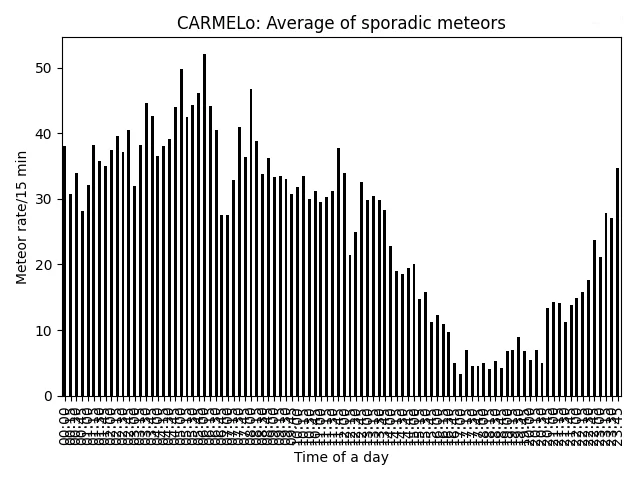
The algorithm for this calculation uses data from the CARMELo network’s database of all meteors recorded, and first requires the user to identify a few days when no significant contributions from meteor showers are presumed to be present. These days are identified as closely as possible to the date being analyzed. This data is then averaged and forms a second database defined as “sporadic averages.”
This database is then subtracted from that of the days under examination, where the presence of a shower is presumed. Any negative values are eliminated, and the profile is smoothed with a smoothing function.
The data is then divided by the sine of the height above the horizon of the radiant, calculated for an average Italian location, similarly to the algorithm for calculating the ZHR (Zenithal Hourly Rate), which we recall is:
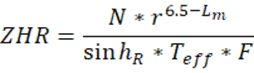
Where:
- N: number of counted meteors.
- Lm: limiting stellar magnitude visible to the observer.
- r: population index of the shower (the ratio indicating how many more meteors are seen per magnitude; typically between 2.0 and 3.5).
- hr: angular height of the radiant above the horizon in degrees.
- Teff: effective observation time (in hours).
- F: correction factor for the field of view.
The temporal resolution, which is originally 15 minutes, is maintained at this value, so the term H in RZHR should be considered as H 4.
Fig.2 shows the artificial sample of sporadic meteors obtained from observational data and used as a reference for subsequent subtraction.
The result of the analysis is shown in Fig. 3, which displays the residual distribution of events along with the position of the radiant of the Eta Aquarids. However, interpreting the data requires particular caution. The Eta Aquarids constitute a rather diffuse shower spread over an extended time interval. Moreover, as mentioned above, at our latitudes the radiant reaches modest heights above the horizon and is only observable in the hours leading up to dawn.
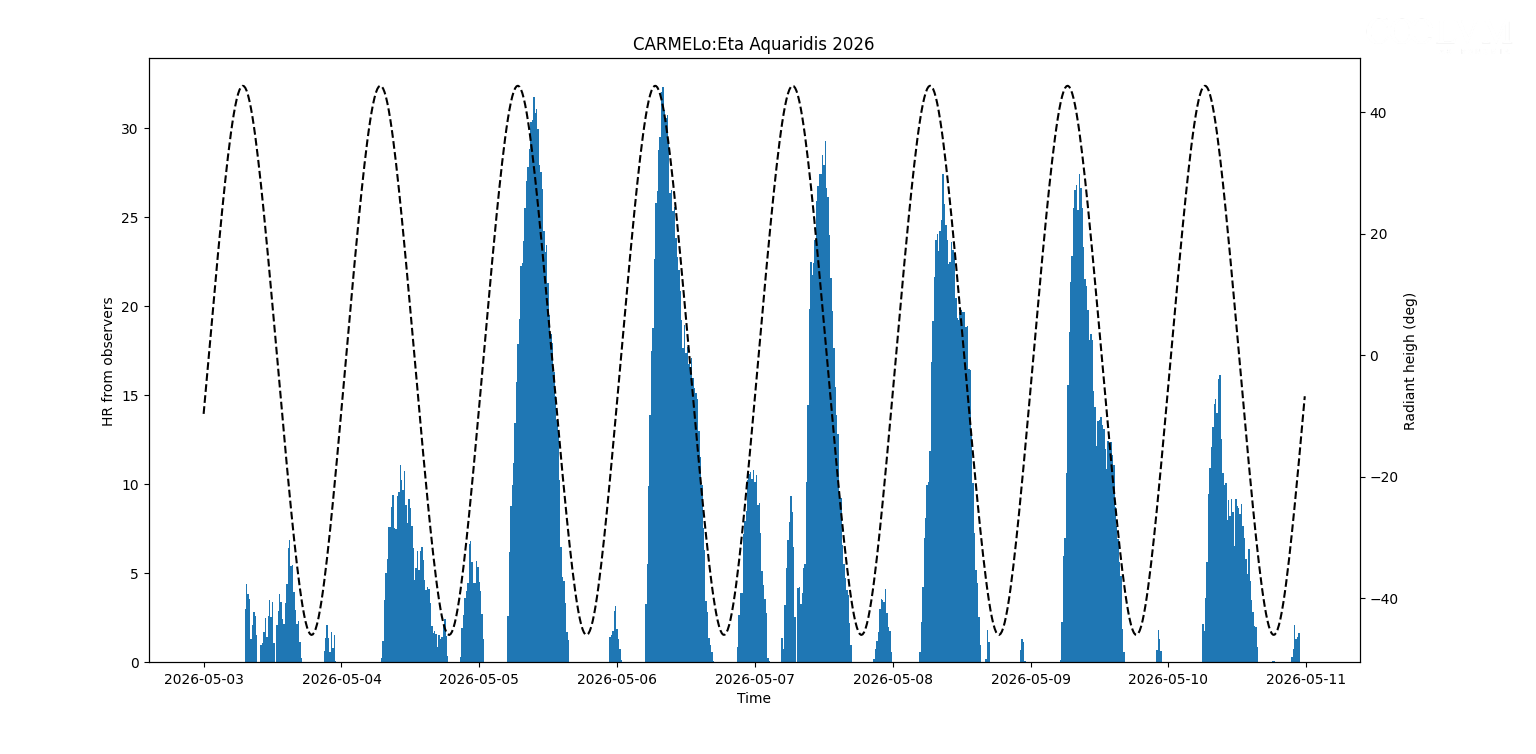
For these reasons, it is not possible to definitively attribute the entire residual signal to the Eta Aquarids. However, with all due caution, this residual can be considered an estimate of the shower's contribution.
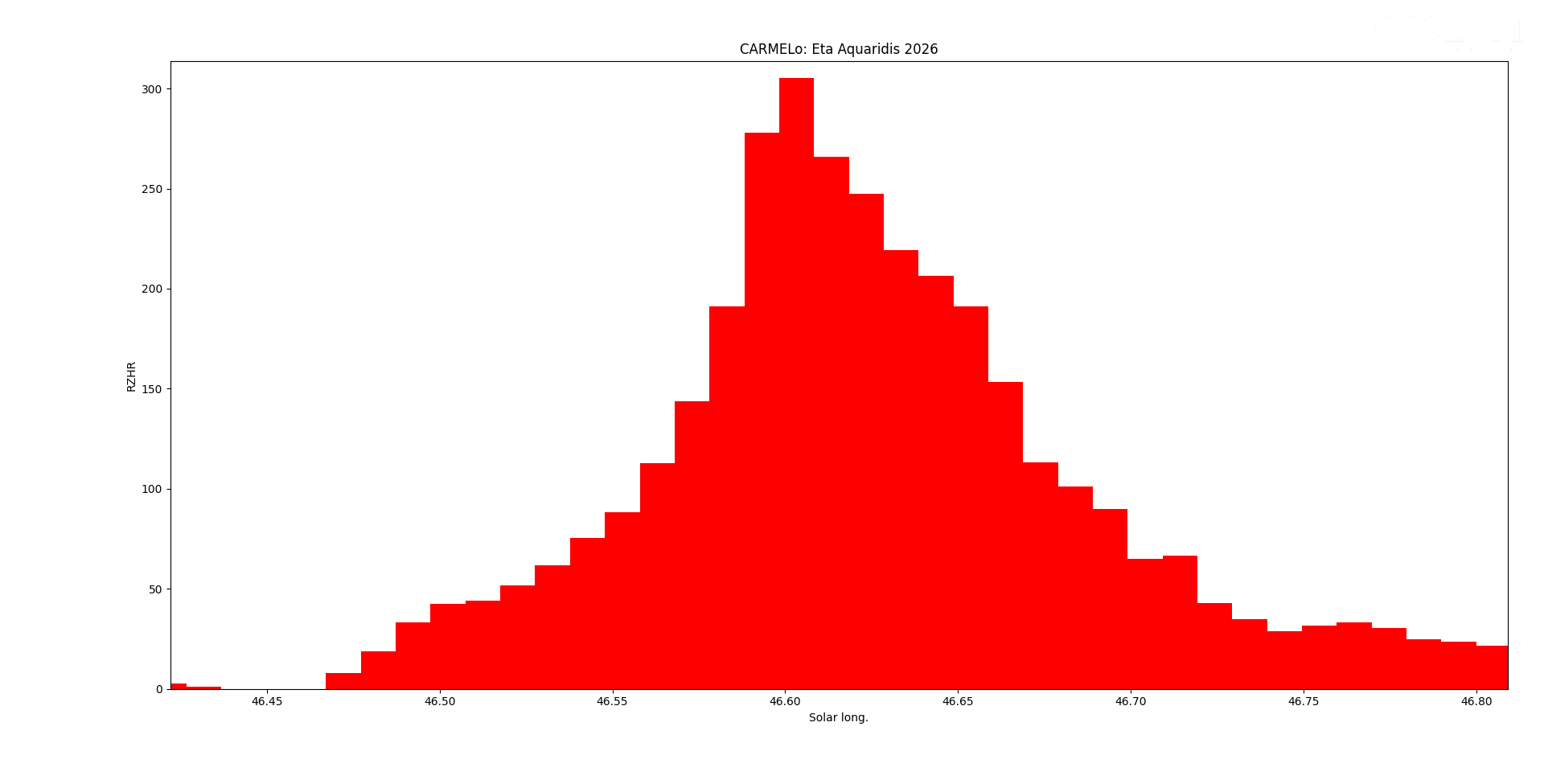
Focusing finally on the day of the expected maximum, May 7, and using solar longitude as the x-axis, we obtain the distribution shown in Fig.5. This reveals a peak of activity corresponding to a solar longitude of 46.6°. This value is consistent with both predictions and results obtained from other observational networks, including the GMN (Global Meteor Network) project.
Instrumentation
The CARMELo network consists of SDR radio receivers. In these, a microprocessor (Raspberry) simultaneously performs three functions:
-
By controlling a dongle, it tunes to the frequency transmitted by the transmitter and tunes in like a radio, sampling the radio signal and measuring frequency and power received via FFT (Fast Fourier Transform).
-
By analyzing the received data for each packet, it identifies meteor echoes and discards false positives and interference.
-
It compiles a file containing the event log and sends it to a server.
All data is generated from a single standard, making it homogeneous and comparable. A single receiver can be assembled with a few devices, the current total cost of which is about 210 euros.
The CARMELo Network
The network currently consists of 16 receivers located in Italy, Spain, the United Kingdom, Switzerland, and the USA. The European receivers are tuned to the frequency of the Graves radar station in France, which is 143.050 MHz. Participants in the network include:
- Lorenzo Barbieri, Budrio (BO) ITA
- Bolognese Astrophile Association, Bologna ITA
- Bolognese Astrophile Association, Medelana (BO) ITA
- Paolo Fontana, Castenaso (BO) ITA
- Pisani Astrophile Association, Orciatico (PI) ITA
- Persicetani Astrophile Group, San Giovanni in Persiceto (BO) ITA
- Roberto Nesci, Foligno (PG) ITA
- MarSEC, Marana di Crespadoro (VI) ITA
- Vicentine Astrophile Group, Arcugnano (VI) ITA
- Ravenna Astrophile Association Rheyta, Ravenna (RA) ITA
- Mike German, Hayfield, Derbyshire UK
- Mike Otte, Pearl City, Illinois USA
- Yuri Malagutti, Comano (TI) CH
- Leslie Fry, Trawscoed Ceredigion, Wales UK
- Brian Coleman, Redenham Observatory, Andover, England UK
- Radio club La Salle University, Barcelona ESP
The authors hope that the network can expand both quantitatively and geographically, thus enabling the production of higher quality data.